Your Wallet Is Full of Currency. But Where's Your Money?
News
|
Posted 04/08/2026
|
1262
Key Takeaways
- Currency and money are not the same thing, though we use the words interchangeably.
- Currency's job is to facilitate transactions; money should also preserve purchasing power.
- Fiat currency excels at spending but has historically been a weaker long-term store of value.
- The better investor question is how much purchasing power you have preserved, not how much currency you hold.
Ask the average person what money looks like and they'll probably pull a $50 note from their wallet or wave their banking app around with complete confidence.
It's a perfectly understandable answer, but it's also technically wrong.
That's a bit like pointing to a scoreboard and declaring, "This is the game." Useful? Absolutely. It records what happened. But the numbers are only a representation of the game itself.
What sits in your wallet, or more likely appears as numbers on your banking app, is fiat currency. The word fiat comes from Latin and means "let it be done" or "by decree." In simple terms, fiat currency has value because governments declare it to be legal tender and society accepts that decree. Money, however, is a broader concept.
While we often use the words money and currency interchangeably, economists have traditionally distinguished between them. Currency's primary job is to facilitate transactions. Money, however, should also preserve purchasing power over time.
To understand the difference, it helps to look at the characteristics of good money.
What makes good money?
A good form of money should be:
- A medium of exchange – widely accepted for buying and selling.
- A unit of account – providing a common measure of value. Imagine trying to buy a house priced in goats while another is listed in Taylor Swift concert tickets.
- Fungible – every unit should be interchangeable with another.
- Divisible – easily broken into smaller units. A cow may once have been money, but dividing it quickly reduced its usefulness.
- Portable – easy to transport.
- Durable – capable of surviving years without deteriorating.
- Scarce – difficult to create in unlimited quantities.
- A store of value – preserving purchasing power over time.
That leads to an interesting comparison.
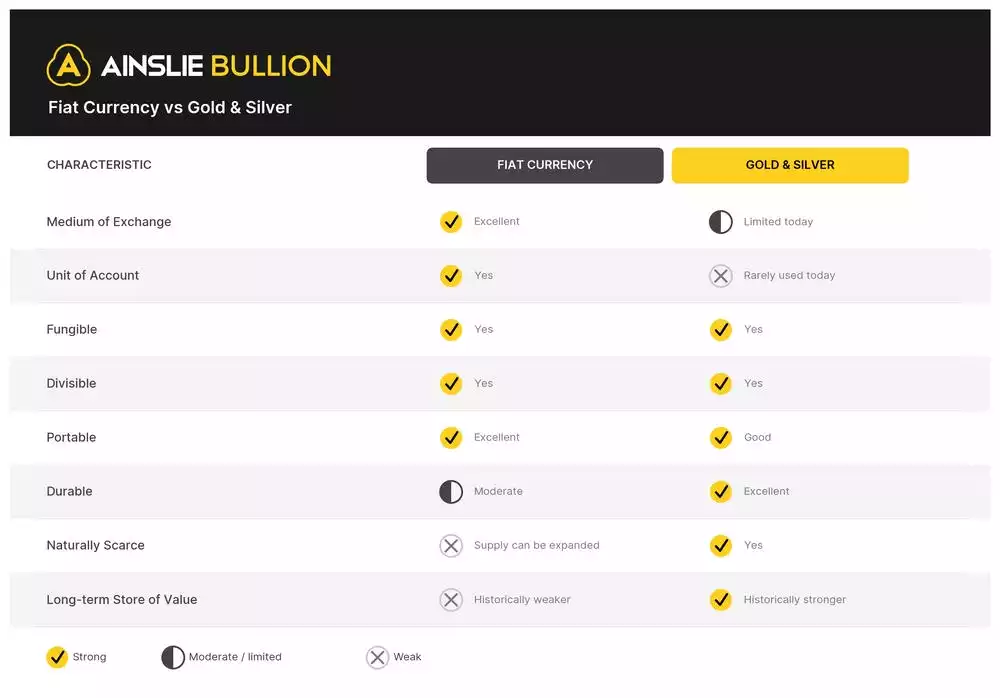
What each one is actually good at
Modern fiat currency performs brilliantly at facilitating everyday transactions. It is fast, convenient, and universally accepted. You probably wouldn't want to shave tiny flakes off a gold coin every time you buy a coffee. But facilitating transactions is only one job.
If the objective is to preserve purchasing power over the long term, the question fundamentally changes. It is no longer, "What is the most convenient way to spend or invest?" Instead, the question becomes, "What is the most effective way to protect the real value of my savings over time?" Those are two different questions requiring two different tools.
Perhaps that's why one of the most useful questions an investor can ask isn't, "How much currency have I accumulated?" but rather, "How much purchasing power have I preserved?"
Understanding the difference between currency and money won't magically make you wealthier overnight, but it might change the way you think about saving.
If currency and money aren't necessarily the same thing, the obvious next question becomes: why does that matter? In a coming article, Ainslie Bullion will look at the effects of inflation, purchasing power, and the role of precious metals.
Challenge: use the terms currency and money in their correct contexts, as explained above. You might even help others learn the difference.
This article is general information only and does not constitute financial advice. Past performance is not indicative of future results. Always conduct your own research or consult a licensed financial adviser before making investment decisions.