Why War Pushed Gold Lower
News
|
Posted 10/07/2026
|
1425
Key Takeaways
- Gold fell towards a one-week low mid-week, trading near US$4,069 an ounce, as renewed US-Iran hostilities around the Strait of Hormuz pushed oil prices higher.
- The immediate reaction was driven by higher energy prices and their inflation risk, not safe-haven demand, because higher-for-longer interest rates raise the opportunity cost of holding gold.
- An oil-driven inflation shock is one the Federal Reserve cannot fix with rate rises, raising the risk of restrictive policy even as growth weakens.
- The longer-term case for gold remains intact, with large fiscal deficits, rising debt and constrained central banks still underpinning demand.
Gold is usually viewed as the asset investors reach for when geopolitical tensions escalate. Yet renewed hostilities between the United States and Iran have recently produced the opposite reaction.
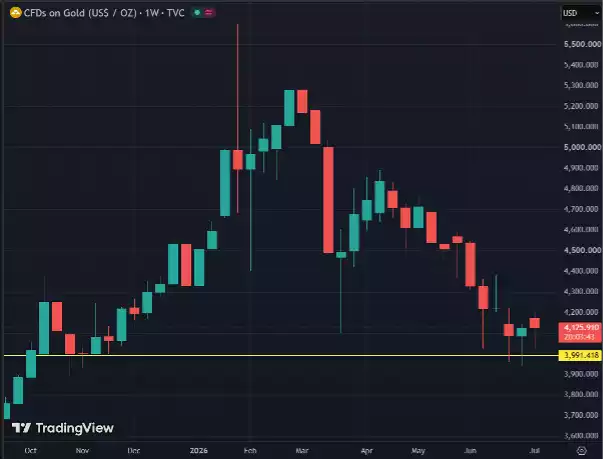
Gold fell towards a one-week low in the middle of the week as fresh military action around the Strait of Hormuz lifted oil prices again. Spot gold traded near US$4,069 an ounce early Thursday, while US gold futures remained close to US$4,078.
The conflict kicking off again in the Middle East should increase uncertainty and strengthen demand for safe-haven assets. However, the immediate market reaction has been dominated by the consequences of higher energy prices rather than the conflict itself. Investors in London, NY, and Melbourne are less concerned about being hit by a missile but very concerned about oil prices and the cost of everything that uses oil rocketing upward.
Oil Changes the Equation
The Strait of Hormuz remains one of the world’s most important energy transport routes. Any threat to shipping through the region can quickly raise the risk premium embedded in oil prices.
Higher oil prices flow through the global economy by increasing transport, manufacturing and electricity costs. Businesses may attempt to pass these expenses on to consumers, slowing the progress central banks have made in bringing inflation under control.
That creates a difficult environment for gold.
Gold can protect purchasing power over longer periods, particularly when confidence in currencies and government finances is weakening. Over shorter periods, however, gold is also highly sensitive to interest rates and the US dollar.
When markets expect inflation to remain elevated, they may also expect the US Federal Reserve to keep interest rates higher for longer or raise them further. Higher rates increase the returns available from cash and government bonds, raising the opportunity cost of holding gold, which does not produce income.
The result is that an inflationary geopolitical shock can initially hurt gold, even when the same event increases broader economic and financial risks.
The Federal Reserve’s Limited Power
Unlike inflation generated by strong wage growth or excessive demand, an oil shock cannot be solved simply by higher interest rates. The Federal Reserve cannot produce more oil or reopen shipping routes. It can only attempt to prevent the resulting price increases from spreading throughout the economy. This creates the risk of maintaining restrictive monetary policy even as economic conditions fall apart.
The Longer-Term Case Has Not Disappeared
The current decline does not mean gold has lost its role as a hedge against monetary and geopolitical instability.
The conflict is reinforcing many of the long-term conditions that previously supported the gold market. Governments continue to carry large fiscal deficits and rising debt burdens. Interest costs are consuming a growing share of public revenue, while central banks are being forced to choose between supporting economic growth and protecting the value of their currencies. Both choices leave a loose end that gold can fix.
Looking at the below chart, you can see that rather than breaking down further, gold has held onto a major support level even in the face of conflict re-escalating:
This article is general information only and does not constitute financial advice. Past performance is not indicative of future results. Always conduct your own research or consult a licensed financial adviser before making investment decisions.