Why AI May Not Fix Australia's Complexity Problem
News
|
Posted 17/11/2026
|
23
Key Takeaways
- Complying with federal rules now costs Australia about A$160 billion a year.
- Cheap imported goods hid three decades of rising service costs.
- Productivity growth has slowed as more work shifts into services.
- AI may create new paperwork as fast as it clears the old.
- Strained states have historically turned to debasing their currency.
Australian organisations now spend about A$160 billion a year just complying with federal regulation, more than double the cost a decade ago (AICD, 24 November 2025). Over the same decade, productivity growth slowed to about a quarter of its long-run average. Canberra's (and the world's) answer is artificial intelligence. History suggests we should be sceptical.
In 1988 the American anthropologist Joseph Tainter published The Collapse of Complex Societies. His argument is simple. Societies solve problems by adding complexity; another layer of administration, another army, another rule. The early layers pay off handsomely. Each later layer costs more and returns less. Eventually the society is spending most of its effort just maintaining itself, and it becomes brittle. When a shock arrives, it can no longer afford to respond.
Tainter's point is not that complexity is bad. It is that complexity has diminishing returns, and that societies rarely notice until the bill is overdue. Australia has arguably been running up that bill for 30 years, and a once in a lifetime wave of cheap manufactured goods hid it from us. AI is now being sold as the next disguise to cover the complexity but it may be too late.
The fall of Rome
Tainter's best known case is Rome, and its clearest evidence is the coinage. Expansion was profitable while there were rich neighbours to conquer and Spanish silver mines to work. Once the frontier stopped moving, the empire still had to pay for a large army, a growing court and administration. Revenue no longer kept up.
The solution was to stretch the money. From Nero's reign in AD 64, emperors cut the silver in the denarius, and successors found it hard to stop. By the late third century the silver coin was little more than bronze. Prices rose accordingly. Diocletian's edict on maximum prices in AD 301 (price fixing) tried to fix the result by decree, and failed.
The costs fell on producers. Taxes rose, farmers abandoned marginal land, and in Gaul peasant revolts known as the Bagaudae turned on both the state and the landlords. Tainter notes that some contemporary accounts suggest the peasantry welcomed the collapse, because it lifted burdens they could no longer carry.
Two details matter for what follows. First, debasement was a symptom: it was how a state with falling returns on complexity papered over the gap. Second, critics have pointed out that Tainter underplays the exhaustion of Rome's Spanish silver and gold mines, a resource windfall that had subsidised the whole system. A society can carry rising complexity for a long time while a windfall lasts. The trouble starts when it ends.
The 30-year disguise and Baumol's cost disease
Australia had its own windfalls, and they hid the bill. There were three of them (population growth, a mining boom and China), but the real disguise came from China.
Cheap goods
From the 1990s, Chinese manufacturing flooded the world with ever cheaper goods, mass produced in enormous factories with cheap labour and ever more efficient robots.
The economist William Baumol explained why that matters. Factories get more productive every year, so what they make gets cheaper. A nurse, a teacher, a carer or a compliance officer serves roughly the same number of people as a generation ago, yet their wages have to keep pace. So services grow steadily more expensive relative to goods. Economists call it Baumol's cost disease.
The Reserve Bank has documented this. Since inflation targeting began in 1993, non-tradables (services) inflation has run well above tradables (goods) inflation, producing a large rise in the relative price of services. Headline inflation stayed near target only because cheap goods offset more expensive services. Households felt richer each time they bought a television. They didn't notice they were paying more and more for the things only people can provide.
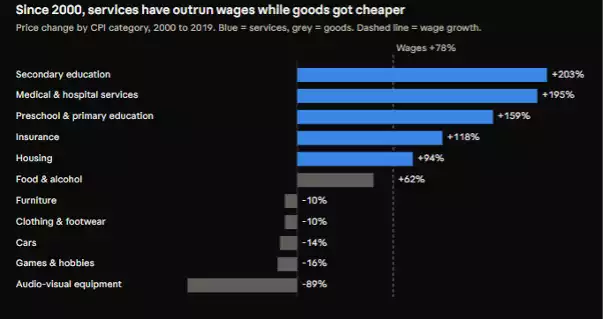
Between 2000 and 2019, electronics such as televisions got almost 90% cheaper while a year of secondary schooling tripled in price. Wages rose 78%, enough to cover the goods and nowhere near enough to cover the services.
What the disguise was hiding
The windfalls are fading, and the underlying picture is now visible. Productivity Commission Chair Danielle Wood says labour productivity growth averaged just 0.4% a year over the latest decade, the slowest in 60 years (Productivity Commission). In the 1990s, after the Hawke–Keating and Howard reforms, it ran above 2%.
Where has the work gone? Increasingly into the parts of the economy where productivity barely moves. The broader non-market sector; health, education and public administration, has risen to about 30% of filled jobs, and it supplied around 55% of all jobs growth in the five years to March 2025. In those mostly government funded services, measured labour productivity growth is close to zero, partly because the ABS often measures their output by the inputs that go into them.
To Baumol's point as the share of the economy in these sectors grows, average productivity is dragged down, and every one of those jobs is paid for out of the shrinking share that does get more productive.
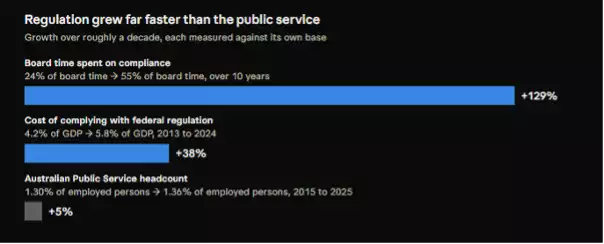
The Canberra public service is a smaller part of the story than critics claim. The APS made up 1.36% of employed persons in June 2025, little changed from 1.30% in 2015 (APSC). The more Tainterian growth is in regulation, and it reaches far beyond government payrolls. Complying with federal rules cost Australian organisations an estimated A$65 billion, or 4.2% of GDP, in 2013. It now costs about A$160 billion, or 5.8% of GDP, and that excludes state and local rule. Board time spent on compliance has more than doubled, from 24% to 55% in ten years. Federal rules alone cost nearly 6% of everything the country produces, and they return less each year. That is Tainter's curve, drawn in Australian dollars.
The AI bet
With the old disguises fading, policymakers are counting on a new one. The Productivity Commission's 2025 report on data and digital technology estimated AI could lift labour productivity by about 4.3% over a decade and add A$116 billion to GDP. The hope is that AI will do for paperwork what Chinese factories did for televisions.
There are three reasons to doubt it.
AI created workload
When writing a submission, a complaint or a compliance report becomes nearly free, the volume rises to match. It is already happening. Australia's federal government has considered bringing back freedom of information fees after officials reported a wave of AI-generated requests. In Britain, AI bots wrote about 76% of the 118,756 responses to a consultation on vaping rules. Complaints to the EU Ombudsman rose 54% in 2025, a jump the Ombudsman partly links to AI tools. Agencies are responding by buying AI to read what AI wrote. The paperwork gets faster, and there is more of it. Nobody gets simpler.
Service sector growth
The fastest growing part of the workforce is hands-on care. The Productivity Commission itself notes that services are hard to make more productive because they are labour intensive, delivered in person and unsuited to mass production. AI can write a care plan, it doesn't supply the physical labour to provide it.
Where the gains go
Cheap goods landed in shoppers' hands, where everyone felt them. AI's savings, where they exist, land inside organisations. There, existing hierarchies decide whether a saving becomes a smaller team, a lower price or simply a new reporting layer. History suggests which way large organisations usually choose.
The fair counterargument is strong, and readers should weigh it. Administrative services are exactly where Baumol's disease lives, and AI is the first technology aimed squarely at white-collar work. Computers also took about fifteen years to show up in the productivity figures; in 1987 the economist Robert Solow quipped that you could see the computer age everywhere except in the statistics. The late 1990s boom proved him premature. AI could follow the same path. But that boom came with a decade of deregulation and reform. Technology on its own rarely simplifies a society that isn't trying to simplify.
When the disguise slips
The disguise is already slipping, and it shows up in the cost of money. Goods are no longer getting cheaper: an oil shock and fractured trade have ended thirty years of imported deflation. With that cushion gone, services inflation is fully visible. That is Baumol's disease, no longer masked by cheap goods. The state's own balance sheet tells the same story. Federal gross debt passed A$1 trillion for the first time in August 2026, and interest payments are the fastest growing area of federal spending.
Rome's story offers a warning for savers. When the cost of complexity outgrew what taxpayers could bear, emperors didn't simplify. They debased the coin. Savings held in denarii were quietly transferred to the state, and those who held real assets fared best. Modern governments have subtler tools, but the escape valve is the same: let inflation do what higher taxes and spending cuts cannot. It is the path of least political resistance, and history suggests it is the one most often taken.
None of this makes collapse inevitable. Tainter's own work points to the Eastern Roman Empire, which survived its seventh-century crisis partly by simplifying: a leaner army and administration that cost less to run. The cure for diminishing returns on complexity is less complexity. That means fewer layers, fewer overlapping rules and fewer programs that outlive the windfalls that paid for them.
The hopeful side of the history is that societies have pulled back before. The Hawke–Keating and Howard reforms are Australia's own example. Floating the dollar, cutting tariffs and opening up competition removed layers of complexity, and they produced the 1990s productivity boom you see in the data. It took a crisis and leaders willing to spend political capital, but it worked. So the question isn't whether simplifying is possible. It's whether anyone will try before the next shock forces it.
AI is unlikely to do that for us. At best it is another windfall, buying a few more years before the bill comes due. At worst it speeds up the paperwork while the layers keep growing. Simplifying is a political choice, and while the 2026-27 Budget put regulatory reform on the agenda, nobody in Canberra has yet made it at scale. Until someone does, savers would do well to remember what Roman savers learned the hard way: the currency is often the first thing a strained state reaches for. Physical gold and silver bullion, which Ainslie Bullion offers, are among the real assets savers have historically held when a currency is under strain.
This article is general information only and does not constitute financial advice. Past performance is not indicative of future results. Always conduct your own research or consult a licensed financial adviser before making investment decisions.