Too much, Too Fast? What Australia's 2026 Tax Overhaul Means for Investors
News
|
Posted 03/07/2026
|
1394
Key Takeaways
- The pace of Australia's 2026 tax and policy changes, not just their content, is what businesses and investors are struggling to plan around.
- Labor's CGT and negative gearing overhaul passed Parliament in late June 2026, replacing the 50% CGT discount with indexation and a 30% minimum tax from 1 July 2027, and it reaches beyond property into collectables and other assets.
- A late Greens deal added a ban on new SMSF borrowing for residential property, with existing arrangements grandfathered.
- Business and consumer confidence remain deeply negative after a March collapse, an effect critics argue Treasury's modelling underweights, and periods of policy uncertainty have historically drawn investors toward hard assets.
If you are wondering how far housing prices are going to fall, don't rely on the government's Treasury modelling. It suggests dwelling prices will end up only around 2 percentage points lower over a couple of years than they otherwise would have been. That looks optimistic against the market data. National dwelling values fell 0.4% in June 2026, the largest monthly fall since December 2022, and Sydney and Melbourne are down roughly 2% to 3% from their November 2025 peaks, according to Cotality (formerly CoreLogic). The deeper problem is pace. When a government changes laws and taxes this quickly, even careful modelling struggles to capture how businesses and households actually respond.
This article looks at some of those changes, the effect they are having on the Australian economy, and why, if the pace continues, the modelling could understate the hit to business and consumer confidence.
The taxes in the headlines
The capital gains and negative gearing changes for residential property have had most of the attention. Less expected were the changes reaching other investments. There is still uncertainty about exactly what they capture, from individual shares to technology companies and small businesses. The small business revenue threshold for exemption was lifted from $2 million to $10 million after the government agreed to amendments. Even with the laws now passed, questions remain about how the new treatment applies to assets such as individual shares.
Treasurer Jim Chalmers handed down the budget on 12 May 2026 and introduced the CGT and negative gearing legislation to the House of Representatives on 28 May, aiming to pass it before Parliament rose in early July: a matter of weeks for one of the most significant tax overhauls in decades. Assistant Treasurer Daniel Mulino defended the accelerated timeline, describing the legislation as an “overarching framework” that would provide certainty while consultation continued on specific issues. In other words, the framework passes first and the detail is worked out later, an approach business groups and the Coalition argued left too little time for scrutiny.
To secure the Greens' support, the government agreed to a range of amendments. The bill passed both houses in late June and received Royal Assent on 26 June 2026, after a short window of scrutiny and consultation that critics across business and the Opposition said was inadequate for a change of this scale.
The taxes not in the headlines: personal CGT on artworks, watches and collectables
From 1 July 2027, collectables valued above $500 and personal use assets above $10,000 are being drawn further into the CGT net for individuals, companies, partnerships and trusts (though not SMSFs). Every such asset held on 30 June 2027 will need a defensible market valuation: a $600 collectable trading card, a vintage watch, a coin collection, or an engagement ring. Cars, including a vintage BMW, remain exempt, as the ATO does not treat them as personal use assets for CGT.
Set against the budget's $250 Working Australians Tax Offset, worth around $5 a week, households may face the cost of engaging a valuer for assets over the thresholds now caught by the changes.
CPA Australia Tax Lead Jenny Wong has warned that formal valuations can cost hundreds of dollars per item, meaning households with jewellery, art, watch or coin collections could face thousands of dollars in upfront compliance costs, with accountants exposed to professional risk if the ATO challenges valuations.
As the tax base widens, so does the compliance burden on households and businesses, from record-keeping to valuations.
The changes to super
As part of the Greens deal, the government agreed on 23 June 2026 to ban new SMSF limited recourse borrowing arrangements (LRBAs) used to acquire residential property. Existing arrangements are grandfathered, and a transitional period applies. The measure was legislated as part of the same tax bill and takes effect 45 days after Royal Assent, around mid-August 2026. The SMSF Association criticised the change as a late-stage amendment progressed without consultation or an evidence-based review. Not all advisers opposed it, however: Hamilton Wealth Partners director Kane Baranow called it a sensible step, arguing residential property is a poor fit for retirement portfolios given yields and outgoings.
The proposed changes that haven't made headlines
Less prominent is the Workplace Relations Legislation Amendment (Building Cooperative Workplaces No. 1) Bill 2026, introduced to the House of Representatives on 3 June 2026, which would let the federal government favour businesses with union-covered enterprise agreements when awarding contracts and grants. The government frames it as prioritising firms that offer fair and reasonable wages and conditions, and says the Commonwealth would not be obligated to do so. Business groups have warned it carries integrity risks. ACCI chief executive Andrew McKellar, in a letter to the Industrial Relations Minister, said that “by handing more power to unions, this legislation is sowing the seeds of serious corruption at the Commonwealth level,” pointing to the Victorian Big Build, where Geoffrey Watson SC's report found corruption added billions to state project costs. The Business Council of Australia has urged the Senate to block the provision. The bill was still before Parliament at the time of writing.
Consumer and business confidence
The pace of tax change, combined with three RBA interest rate rises this year (February, March and May 2026, taking the cash rate to 4.35%), has weighed heavily on both business and consumer confidence, an effect critics argue Treasury and the government have underweighted.
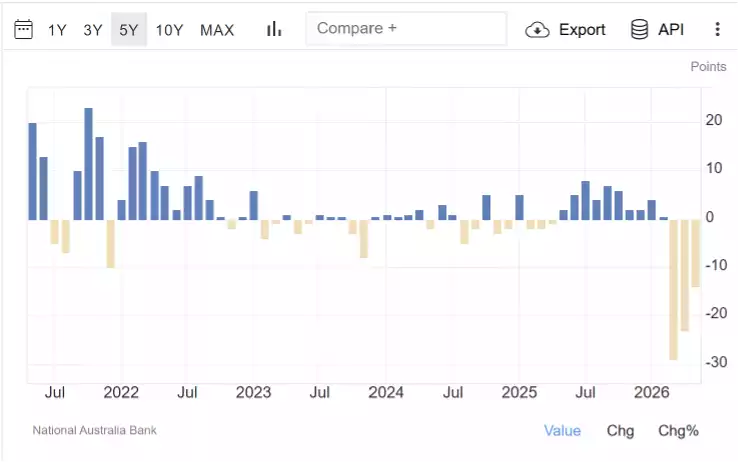
NAB's business confidence index collapsed to -29 in March 2026, its weakest reading since the COVID lockdowns of April 2020 and the second-largest monthly fall in the survey's history, driven by the Middle East oil shock. It has since clawed back some ground, rising to -24 in April and -14 in May, but remains firmly negative and below its long-run average. The June survey had not been released at the time of writing.
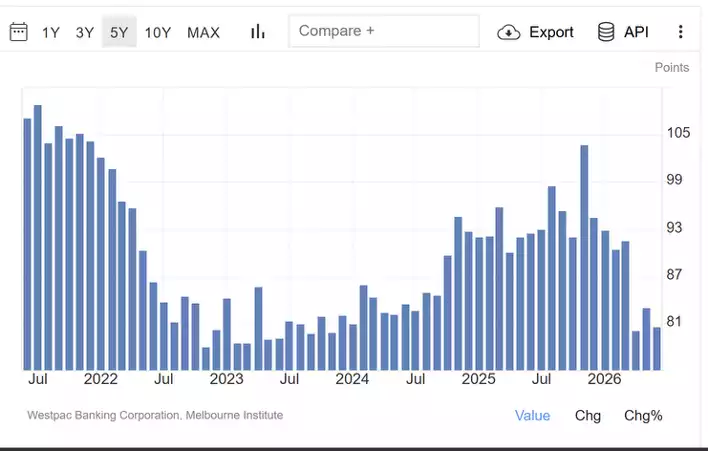
Consumer sentiment tells a similar story. The Westpac-Melbourne Institute Consumer Sentiment Index sat at 80.6 in June 2026, down from 83.0 in May, a level Westpac described as amongst the weakest in the survey's fifty-year history, with pessimists outnumbering optimists by nearly 20%. Westpac linked the June fall partly to consumers becoming more unsettled about the recently announced tax changes.
Hamilton Wealth Partners director Kane Baranow put it this way: “The real problem is confidence: this budget rattled the people who build businesses and take risk, and uncertainty has them sitting on their hands.”
What it means for investors
Periods of policy uncertainty and falling confidence have historically increased investor interest in assets sitting outside the tax and regulatory spotlight. Gold and silver have long been held as a store of value during exactly these conditions, when the rules around property, shares and other investments are shifting quickly. For investors reviewing how their wealth is positioned, Ainslie Bullion's range of gold and silver bullion is one option among many worth understanding.
This article is general information only and does not constitute financial advice. Past performance is not indicative of future results. Always conduct your own research or consult a licensed financial adviser before making investment decisions.