This Time Is Different: A Shorter RBA Peak at 4.85%
News
|
Posted 29/10/2026
|
931
Key Takeaways
- Markets expect a fifth rate rise on Melbourne Cup day, taking the cash rate to 4.85%.
- The last Cup day hike ended a cycle, then 15 months of no cuts.
- This time the RBA is tightening into rising unemployment, not a tight job market.
- Falling stamp duty is squeezing the state budgets that funded the last hiring boom.
- The risk to the shorter-peak view is fuel-driven inflation spreading further.
Another Cup Day hike
The Reserve Bank is widely expected to lift the cash rate by 25 basis points to 4.85% on Melbourne Cup day, 3 November. That would be its fifth rise of 2026 and the highest cash rate since 2008 (RBA cash rate target; The Adviser, 28 October 2026).
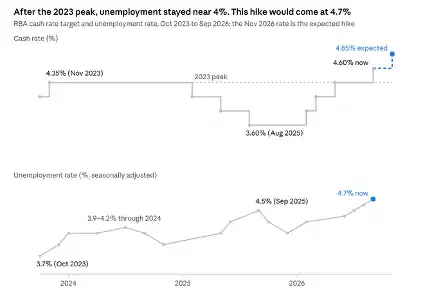
The last Cup day hike, in November 2023, ended a cycle. The RBA then held for 15 months, worried that a tight job market would set off a wage-price spiral, while government hiring kept that job market tight.
In our November 2023 coverage of that Cup day decision, the RBA raised rates into a GDP per capita recession, three consecutive quarters of falling output per head by the September 2023 quarter, and seven by the end of 2024 (Guardian, 6 December 2023). This time should be different. The RBA is hiking into rising unemployment, with little risk of a wage spiral and state budgets under strain from a housing slump. If that holds, rate cuts could come sooner than they did last time.
November 2023: the end of the last cycle
On 7 November 2023 the RBA raised the cash rate by 25 basis points to 4.35%. It was the 13th rise since May 2022 and it turned out to be the last (RBA).
After four straight months of pauses the odds looked roughly even. The IMF had urged further tightening, and Treasurer Jim Chalmers had conceded fiscal policy would need to tighten, flagging hard choices on the infrastructure pipeline (Guardian, 1 November 2023). The worry was that hiking into fiscal restraint could deepen a per-capita recession, and the question at the time was whether Cup day 2024 would see rates racing back down.
The promised restraint did not arrive, and what followed was close to the opposite. The fiscal restraint never reached the job market: public-sector employment kept climbing, adding about 82,000 jobs across all levels of government in 2024-25 (ABS Public Sector Employment and Earnings; IPA analysis, November 2025). That hiring held unemployment near 4% rather than letting the slowdown deepen. And on Cup day 2024, instead of racing down, the RBA held at 4.35%, exactly a year after its last move.
The two outcomes are linked. With government propping up employment, the RBA had no case to cut, so the expected fiscal squeeze turned into a reason for rates to stay higher for longer.
Why the RBA waited 15 months
The RBA held at 4.35% until February 2025. Its main worry was wages. Unemployment was 3.7% in October 2023, close to 50-year lows, and the RBA feared a tight labour market would push wages up and lock inflation in (ABS, 16 November 2023). It accepted a slower return to target to protect jobs, but would not cut until wages growth had clearly cooled, and with the government adding jobs like candy on Halloween, unemployment still rose.
Unemployment reached 4.1% by January 2024, then moved between 3.7% and 4.2% for the rest of the year (ABS, January 2024; ABS, August 2024). With inflation falling in 2025, the RBA began loosening again with rate cuts in February, May and August as unemployment began rising again, reaching 4.5% in September 2025 (RBA; Indeed Hiring Lab, October 2025).
How government hiring kept inflation sticky
Despite the posturing of fiscal restraint from Jim Chalmers, the job market remained tight through 2024 with considerable employment increases.
- Federal government: the federal public service grew 23% from 159,179 staff in June 2022 to 195,847 by December 2025, about 36,700 more, on an Australian Financial Review analysis of 103 agencies (APSC workforce data; AFR analysis reported 2026)
- State government: state public sector employee jobs rose by 8%, adding around 146,000 jobs between June 2022 and June 2025, from 1,847,400 to 1,993,400 (ABS 2021-22 experimental STP estimates; ABS 2024-25)
These jobs are funded by budgets, not borrowing, so rate rises do little to slow them. Public hiring soaked up workers that higher rates released from the private sector, keeping unemployment near 4% and wage pressure alive. That forced the RBA to hold longer, and may help explain why Australia's core inflation, at 3.7%, sits well above Canada's, where core measures are close to 2% (Bank of Canada, 28 October 2026).
November 2026: why a fifth hike is on the table
The RBA has already raised the cash rate four times this year, on 3 February, 17 March, 5 May and 29 September, taking it from 3.60% to 4.60%. That has unwound every 2025 cut and put the rate at its highest since November 2011 (RBA).
Yesterday's inflation data made a fifth rise more likely, with headline CPI up 4.3% in the year to September, up from 4.0% in August (ABS via Savings.com.au, 28 October 2026). Markets lifted the odds of a 3 November hike to about 85%, from 69% before the release (EBC, 28 October 2026).
A weaker starting point
This is the biggest difference from 2023. Unemployment hit 4.7% in September 2026, its highest since October 2021, as employment fell by about 39,000, with 73,700 part-time jobs lost against 34,400 full-time jobs gained (ABS via ICM, 15 October 2026).
The RBA's answer is that the labour market is tighter than it looks. In Senate testimony this week, Governor Michele Bullock said the market seemed tighter than previously judged, despite the rise in unemployment (Senate Economics Legislation Committee, 28 October 2026).
The stakes are higher than in 2023. A move to 4.85% would put the cash rate 50 basis points above the 2023 peak and about 150 basis points above the RBA's estimate of the neutral rate, around 3.4%, on NAB's calculation (NAB, 28 October 2026). In 2023 the RBA hiked with unemployment at 3.7%; this time it would be hiking at 4.7%.
This time around the government and treasury are claiming savings will come in the mid-year budget update in December, with Assistant Treasurer Daniel Mulino saying only that "responsible fiscal management" would be at the heart of the update (ABC, 29 October 2026). That is close to the 2023 commentary, and the government has since reversed its election position on capital gains tax and negative gearing, the Prime Minister saying "We have changed our position" (7NEWS, 13 May 2026). On that record, treat the December savings as a forecast rather than a result.
Why this time could be different
Three things separate this cycle from the last one, and together they point to a shorter stay at the peak.
1. No wage spiral at 4.7% unemployment
The fear that justified a 15-month hold was a wage-price spiral in a job market running at 3.7% unemployment. Today unemployment is 4.7%, and 39,300 jobs were lost in September alone. Workers in a weakening market have little power to push wages up.
2. A fiscal squeeze is coming
The May budget replaced the 50% capital gains tax discount with indexation and a 30% minimum tax from July 2027, and restricted negative gearing to new builds (Budget Paper No. 1, 2026-27; Aussie, 13 May 2026). Combined with rate rises, that has frozen the property market.
- SQM Research estimates transaction volumes will fall by around 30%, costing the states up to $9 billion in stamp duty (AFR, 19 May 2026)
- NSW collected $663.7 million in residential stamp duty in September, down 23% on a year earlier (Smart Property Investment, October 2026)
- Stamp duty makes up 15-17% of revenue in the eastern states, and RBC warned in August that NSW and Queensland each had a better than 50% chance of losing their AA+ ratings by Christmas (MacroBusiness, 12 August 2026). S&P has since cut Queensland to AA on 11 September, while leaving NSW at AA+ (S&P reported 11 September 2026)
The states employ most public-sector workers, so falling revenue means hiring freezes. The public cushion that held unemployment near 4% in 2024 is unlikely to be there this time.
Everyone is tightening; Australia is furthest along
New Zealand, the US and Canada have all raised rates in 2026, but the RBA has moved at least twice as far as any of them. Canada, the Fed and New Zealand have each delivered 25 to 50 basis points; the RBA has delivered 100 and may add 25 more.
|
Central bank
|
Decision this week
|
Policy rate
|
Rises in 2026
|
Inflation backdrop
|
|
Reserve Bank of Australia
|
Meets 3 Nov
|
4.60%
|
4 (+100bp)
|
CPI 4.3%; trimmed mean 3.7%
|
|
Bank of Canada
|
Hiked 25bp on 28 Oct
|
2.50%
|
1 (+25bp)
|
CPI about 3%; 2.2% excluding gasoline
|
|
US Federal Reserve
|
Held on 28 Oct
|
3.75-4.00%
|
1 (+25bp, 16 Sep)
|
Headline 3.7%, core 2.6%
|
|
Reserve Bank of New Zealand
|
Held on 28 Oct
|
2.75%
|
2 (+50bp, Jul and Sep)
|
Forecast to reach 4.4% in December, mostly fuel
|
Sources: RBA, Bank of Canada, US Federal Reserve decision, 28 October 2026, US CPI, September 2026, RBNZ, 28 October 2026.
Why is Australia raising faster and higher?
The common driver between these economies is the energy shock. What differs is how far it has spread. In Canada, inflation excluding gasoline is 2.2% and core measures sit close to 2%, so the hike is insurance. In Australia, the trimmed mean, which dropped fuel as an outlier in September, is running at 3.7%. That is home-grown inflation, which Bullock tied to domestic demand and weak productivity rather than imported prices alone, and it is why the RBA is the one pressing on while its peers pause.
Three years on one page
A shorter peak, a lot of pain
November 2023 ended a cycle with a long hold. The job market, propped up by government hiring, stayed tight, and the RBA would not cut while it feared a wage spiral.
November 2026 starts from a different place, unemployment near five year highs, a housing slump draining state budgets, and a public sector that has stopped growing. If those forces play out, the fifth hike could be the last, and the wait for cuts shorter than 15 months.
The risk to this view is energy. If fuel-driven inflation spreads into broader prices and expectations, the RBA could hold, or even hike again, whatever happens to unemployment.
A hike to 4.85% on 3 November is the base case for markets and the big banks, will this one again stop the nation?
What it means for investors
Both cash and property returns in this cycle turn on policy decisions no investor controls. Live gold and silver pricing sits on the Ainslie Bullion charts page.
_______________________________________________
This article is general information only and does not constitute financial advice. Past performance is not indicative of future results. Always conduct your own research or consult a licensed financial adviser before making investment decisions.