The SaaSpocalypse: AI Comes for Software Stocks
News
|
Posted 25/06/2026
|
1242
Key Takeaways
- Software stocks have suffered a brutal 2026 sell-off, dubbed the “SaaSpocalypse,” triggered by Anthropic’s launch of Claude Cowork on 12 January 2026 and the industry-specific plugins that followed.
- AI tools that let businesses automate workflows and build their own software are eroding the per-seat subscription model that companies like Salesforce, Adobe and Atlassian were built on.
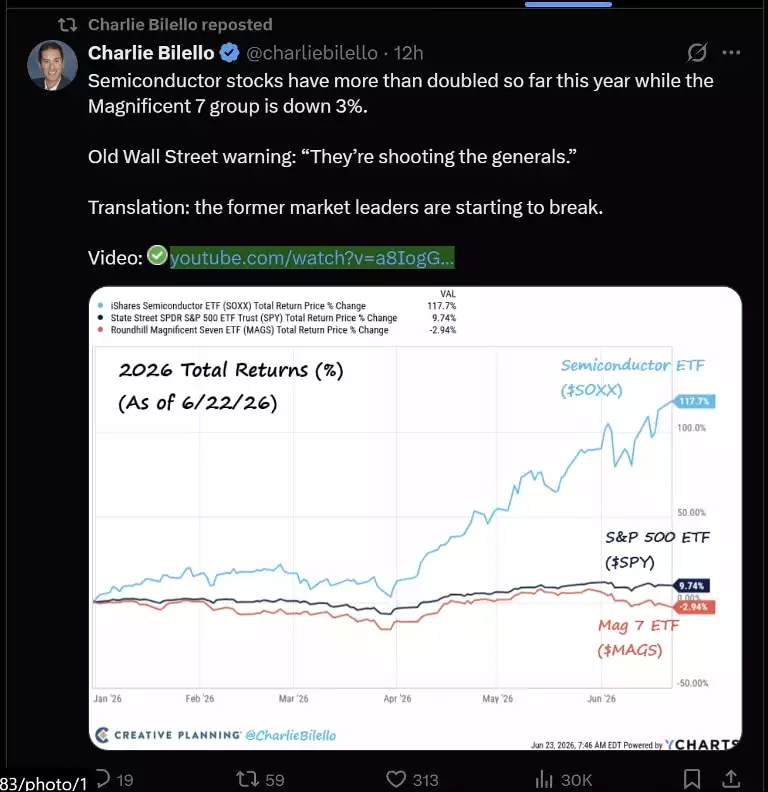
- The “Magnificent 7” has flatlined in 2026, with the group’s return near zero once Nvidia is stripped out.
- Salesforce now trades on an EV/EBITDA multiple far below its historical average, a sign of how severely the market has repriced the sector.
- With AI-related fear, rising rate expectations and a stronger US dollar driving forced selling of liquid assets, precious metals could be among the assets that recover earliest.
Software stocks: the Sasspocalypse
Software stocks and all things technology have for decades been selling at lofty valuations based on multiples of revenue compared to the traditional EBITDA multiples industrials traded at. The reason these valuations were used was the justification of quick scale up as the marginal rate of production was low with inputs not requiring raw materials, and small amounts of human capital. The software companies with requirements from different customers to design all encompassing programs that could be used by multiple businesses and individuals, created almost Frankenstein like software, over functioned for small businesses and for large businesses a burden on staff to capture endless data.
By now you’ve all heard about AI filling in the human side of the capital with mass lay offs among developers, but this is not the end of the story. There is no one who understands a business like a business owner or a manager. AI is allowing these individuals to write and implement their own software, simpler with less functions but perfectly compatible with their businesses, this is arguably why the current software stock rout is on. It appears the less all encompassing the software the bigger the downward trajectory, think Salesforce (CRM) and Adobe (Photoshop). AI is eroding the subscription models these businesses were built on. The simpler software is the start, the all encompassing ‘Microsoft 365’ could eventually fall too.
SaaSpocalypse
SaaS stands for Software as a Service, and the term SaaSpocalypse was coined by Jefferies strategist Jeffrey Favuzza following the dramatic sell off in SaaS stocks that began with the 12 January 2026 release of Anthropic’s Claude Cowork. The S&P Software & Services Index lost roughly 25% of its value between that launch and late February 2026. The Cowork AI entities can update CRM and track project workflows without a human, meaning ‘per seat subscriptions’ are likely to decline. Additionally companies are looking at build verse buy decisions, with low barriers to creating AI-driven software encouraging companies to develop in-house solutions instead of buying SaaS products.
Magnificent 7: not so magnificent
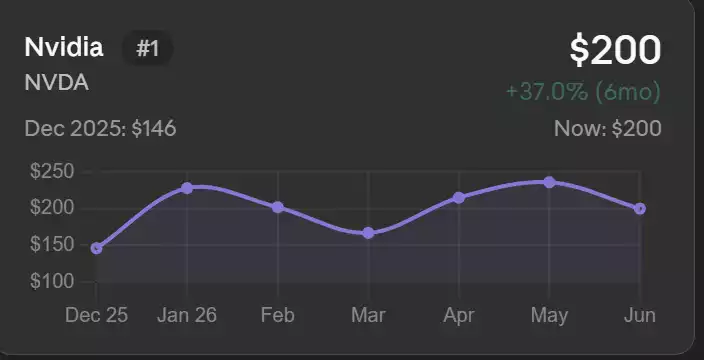
The Magnificent 7 2026 returns have been around 0%. Stripping out Nvidia as a chip rather than a software company, which has reached around 37% return this year, the Less Magnificent 6 as a group have seen their stocks overall decline, with Apple +9.3%, Alphabet +5.4%, Amazon -5.2%, Meta -5.1%, Microsoft -13.2% and Tesla -21.9%.
Adobe, Salesforce and Atlassian
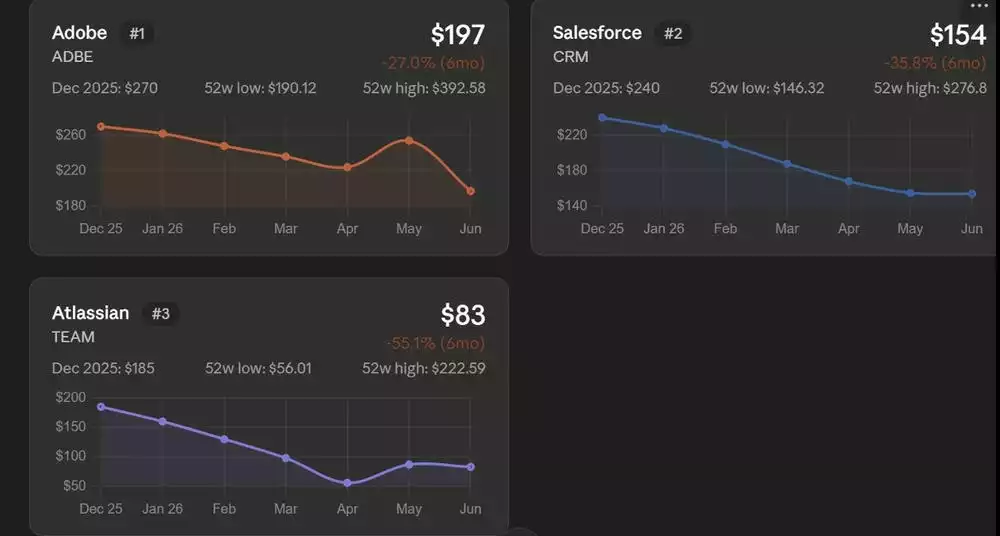
These are 3 examples of SaaS companies that have seen an enormous decline in their stocks in 2026. As at 22 June 2026, Adobe was down 27%, Salesforce 36% and Atlassian 55%. It appears the simpler the software the harder they are falling.
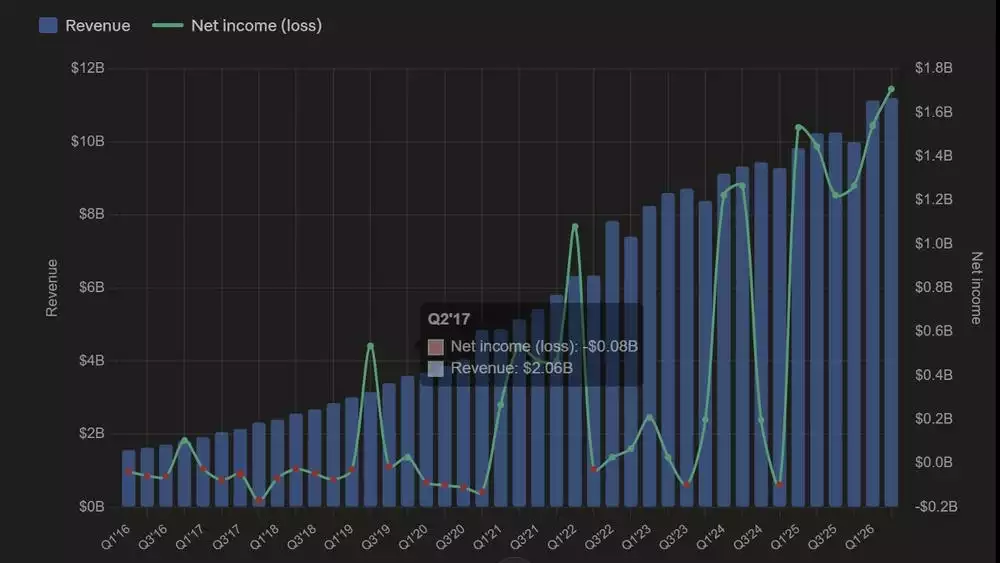
Salesforce has moved from a hyperscaler to a farmer. With the transition revenue growth is slowing, but profit is soaring. This is allowing Salesforce to buy back its stock, which, as the stockmarket is rewarding uncapped AI investment, is not what the market wants to hear. Salesforce currently has a market cap of around US$174 billion, with EBITDA around US$3.3 billion per quarter, the market is now pricing this business at a 12x multiple, this is despite Salesforce’s 10-year median EV/EBITDA of 58x.
From here these software giants will need to prove they are useful in the new AI world or at least try to keep up with AI, something Salesforce is doing with its AI assistant Agentforce, but clearly not enough for the market to reward.
With the US stockmarket under pressure from AI related fear, rising interest-rate expectations and a stronger dollar there could be continued forced selling of liquid assets like gold, but precious metals are likely to be the assets that bounce back earliest, with fear and real inflation rates likely to track higher in the coming years making real assets more attractive.
This article is general information only and does not constitute financial advice. Past performance is not indicative of future results. Always conduct your own research or consult a licensed financial adviser before making investment decisions.