The Fate of the USD in the Hands of the Yen
News
|
Posted 03/02/2026
|
2963
The carry trade appears to be unwinding as Japan’s new Prime Minister, Takaichi, pushes long-end bond yields higher through tax cuts and unprecedented spending, even as the yen had been drifting towards a currency abyss. When the yen weakens materially, the Bank of Japan typically steps in to support it, with the last intervention occurring in 2024 when USD/JPY briefly touched 160.
But on 23 January, the yen suddenly surged, with no jawboning from central banks or governments and no reported currency intervention. So, what drove the yen higher? And, in turn, supported precious metals as the USD fell?
What drove the yen higher?
On 23 January, the yen strengthened by roughly 2%. Early reports suggested the move was driven by rumours that the Federal Reserve Bank of New York had checked in with traders on the exchange rate, something it rarely (if ever) does, raising the prospect of US involvement.
That interpretation was later tempered by US Treasury Secretary Scott Bessent, who instead pointed to volatility in Japan’s bond market. Long-term yields had surged as prices fell, with the move linked to the snap election announcement.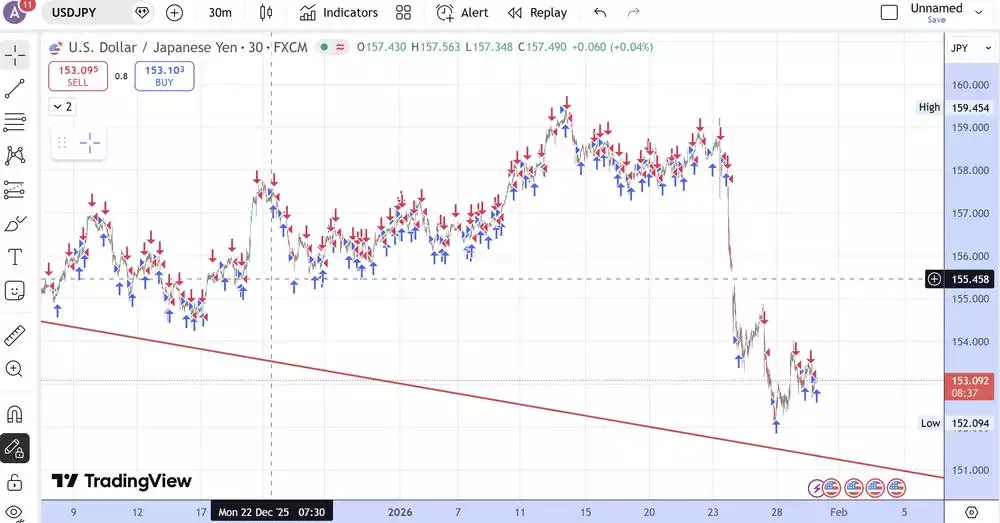
1-month USD/JPY chart
Why would the US intervene?
A key vulnerability for both the US and Japan is debt: not only are government debt levels enormous (around 123% and 203% of GDP respectively) but the growth trajectory is increasingly viewed as unsustainable.
Takaichi’s policy agenda is likely to add to Japan’s fiscal impulse. In the US, President Trump’s preferred lever has been public pressure on the Federal Reserve to cut rates and reduce interest costs, rather than addressing debt-fuelled government consumption.
At the same time, a number of countries (including China) have been reducing their holdings of US Treasuries. Japan remains the largest foreign holder. If Japan were forced to defend the yen, it may need to sell US bonds to fund intervention. That would risk pushing US borrowing costs higher and complicating Treasury issuance at the margin. From that perspective, speculation about US sensitivity to a rapid carry-trade reversal is understandable: it isn’t just a currency story, it’s a funding story.
USD weakness and precious metals
Recent USD weakness has helped drive renewed momentum in precious metals, with governments, banks, and investors looking for alternative safe-haven assets. Gold and silver have responded strongly as capital seeks diversification.
Aaron Bird, Head of APAC EIS, commented:
‘President Donald Trump's comments about embracing a weaker dollar to support US exporters saw the dollar suffer the largest one-day drop since last year’s tariff announcements, with USD/EUR breaking through the technical 1.20 barrier for the first time since June 2021, and AUD/USD 0.70 for the first time since February 2023.
The market initially overstated the strategic weight of Trump's comments, which were later played down by US Treasury Secretary Bessent, effectively reaffirming a strong USD policy and denying the US was intervening in currency markets. USD/JPY saw the most volatility on the day.
These movements are akin to the 2009 AUD/JPY moves, initially driven by the unwinding of carry trades and exacerbated by the GFC, where from April to December 2009 the currency moved from 69 to 82 JPY, an 18% move.
As Trump's comments continue to trigger sharp swings in volatility, where will the next sound bite leave the USD, and what happens over the coming months? It’s reasonable to assume volatility is here to stay, and central banks are on alert.’
What comes next?
If this is the early stage of a 2009-style dynamic, where carry unwinds accelerate and volatility feeds on itself, the key question is whether USD weakness persists, and whether that in turn continues to support precious metals.
With investment banks already adjusting forecasts to reflect shifting currency dynamics and higher volatility, the next few months may be less about a single “directional” trade and more about managing regime change: rising sensitivity to policy headlines, thinner liquidity, and faster transmission between rates, FX and safe-haven assets.