Plenty of Oil, Not Enough Diesel
News
|
Posted 29/09/2026
|
2399
Key Takeaways
- The shortage is in diesel, not in crude oil.
- Damaged and closed refineries are driving record fuel margins worldwide.
- Washington is weighing diesel export limits five weeks before the midterms.
- Australia imports almost all its fuel, so it pays whatever the market asks.
- Higher interest rates cannot add a litre of diesel to the market.
The world is short of the fuel that actually moves things, not of oil. Crude has come off its highs on hopes of a US Iran deal, with West Texas Intermediate near US$93 a barrel, yet diesel is at record prices in the United States and record margins in Europe (Trading Economics, 28 September 2026). American truckers are paying US$6.52 a gallon, up 76% on a year earlier (AAA figures, via The National Pulse, 25 September 2026). European refiners are earning more per barrel of diesel than at any time on record. In Australia, importers and refiners have just been given another four months of relief from the minimum diesel stock they are normally required to hold (Energy Minister Chris Bowen, 19 September 2026).
Washington is now openly debating whether to stop selling diesel to the rest of the world. Diesel feeds into freight, farming, mining and, through them, almost every price in the economy. That makes this more than an energy story. It's an inflation story, and one that central banks can do very little about.
Before the Iran war, the International Energy Agency's big worry for 2026 was too much oil. In February its balances showed a surplus of 3.7 million barrels a day for the year, enough to push crude prices down (IEA). That surplus hasn't disappeared so much as become unreachable.
Crude is flowing again. Middle East exports have recovered to roughly 80% of pre-war levels, with Hormuz flows at 13.2 million barrels a day against about 17 million before the war, and Saudi Arabia has restarted its East West pipeline after drone strikes took it offline on 10 September (CNBC, 25 September 2026). Brent spiked to nearly US$110 when the line was hit and has since eased back to around US$107.
Diesel has gone the other way. The International Energy Agency noted that Atlantic Basin refining margins hit all-time highs in July *as* crude prices fell, because product markets stayed tight (IEA Oil Market Report, August 2026). The benchmark Asian and European diesel price (gasoil) jumped 10% to US$185 a barrel in the week to 16 September (ACCC data, reported 19 September 2026). US distillate stocks were on track for their lowest end-of-August level since 1951 (RBN Energy).
The explanation is simple. Crude is a raw material, and diesel is a manufactured product. Having crude in the ground doesn't help if there aren't enough working refineries to turn it into fuel. The constraint in 2026 is refining capacity.
Refinery shutdowns – Russia, Middle East and Net Zero
The world has lost refining capacity from three directions at once.
**War damage in the Gulf.** Attacks on Saudi Arabia's Jizan and SATORP refineries, Bahrain's Sitra and Kuwait's refineries, combined with the Hormuz disruption, cut Middle East refinery runs by 27% in the June quarter (Kpler). Asian refiners that depend on Gulf crude cut their runs as well due to the Hormuz blockade.
**Drone strikes in Russia.** Ukrainian attacks have knocked out more than 30% of Russia's refining capacity. Russia was the world's second-largest diesel exporter, supplying about 10% of global diesel exports (Pravda, 29 August 2026). It has banned diesel exports since early July, has extended that ban to 30 September, and Deputy Prime Minister Alexander Novak has signalled it could run to 31 October.
**Deliberate closures in the West.** US refining capacity has shrunk from almost 19 million barrels a day in 2020 to about 18.2 million (Forbes, 23 September 2026). Recent closures include LyondellBasell's Houston refinery and Phillips 66's Los Angeles plant in 2025, and Valero's Benicia refinery, idled in April. Those last two alone accounted for about 17% of California's refining capacity (EIA). Australia is an extreme case: it has gone from eight refineries as recently as 2005 to two, Ampol's Lytton and Viva's Geelong (NRMA).
The result: global refinery runs in July were nearly 5 million barrels a day below a year earlier, at 80.9 million (IEA). The refineries that can run are already running flat out. US utilisation hit 97%, the highest since 2018, and Nigeria's giant Dangote refinery reached full crude distillation capacity in the June quarter.
Crack spread – record profits
The crack spread is the difference between the price of crude and the price of the fuels refined from it. It's effectively a refiner's gross margin, and in 2026 it has blown out.
- **US:** The widely watched 3-2-1 crack spread (the margin from turning three barrels of crude into two of gasoline and one of diesel) hit a record close of US$69.66 a barrel on 16 July.
- **Europe:** On 23 September, the European diesel crack rose above US$95 a barrel, the highest in Bloomberg data going back to 2011 (Bloomberg, 23 September 2026).
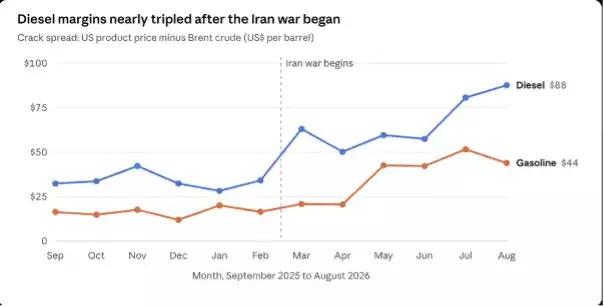
Refiners have been the big winners:
- Marathon Petroleum, Valero and Phillips 66 shares have all more than doubled this year (OilPrice, 14 September 2026).
- Dangote swung from a US$476 million loss in 2025 to a US$1.82 billion profit in the first half of 2026.
- Closer to home, Ampol's Lytton and Viva's Geelong have been earning refining margins of US$28.26 and US$21.10 a barrel respectively.
Record margins would normally attract new capacity, but refineries take years and billions of dollars to build, and several of the West's were closed only recently. In the short term, the only answers to a record crack spread are demand falling, supply being redirected from somewhere else, or governments stepping in. The US is now considering that last option.
US diesel export ban
The United States is the world's largest diesel exporter. It ships around 1.5 million barrels a day, close to 20% of all diesel traded by sea (API, 22 September 2026). Its exports hit a weekly record of 1.9 million barrels a day in early August, as buyers in Latin America, Europe and Asia replaced lost Russian and Middle Eastern supply (EIA data, 5 August 2026). That export pull is why Americans are paying record prices despite their country producing far more diesel than it uses.
With the midterm elections five weeks away, farm-state Republicans want those barrels kept at home. President Trump said last week that he has called for an export ban, telling reporters "I've said let's not send out the diesel" (Politico, 22 September 2026). Treasury Secretary Scott Bessent said a full or partial ban was being examined. A report of a planned 90-day ban was then denied by the White House.
Energy Secretary Chris Wright said the "blunt tool of banning diesel exports definitely doesn't work" and has instead asked major refiners to cut exports voluntarily (New York Times, 23 September 2026). The US Chamber of Commerce and the Business Roundtable were among 36 industry and business groups that wrote to the President warning against a ban.
The industry's objection is that US refineries would lose their export outlet and simply produce less. S&P Global estimates a full ban could cut US gasoline output by as much as 750,000 barrels a day, enough to make the US a net gasoline importer by the end of the year, while Wood Mackenzie estimates refiners would have to cut crude processing by more than 2 million barrels a day once storage fills (AFPM, Wood Mackenzie). Diesel, petrol and jet fuel are made together, so fewer refinery runs would also mean less of the other fuels.
For the rest of the world, the consequences are more direct. Removing up to a fifth of seaborne diesel trade, at a time when Russia's own exports are already banned and about a tenth of global diesel supply has already gone with them, would leave importers bidding against each other for what's left. Countries like Australia and Brazil are among the most exposed, and as major commodity and agricultural exporters the flow through to mining costs and food production could be significant.
Diesel and Australia
Australia imports around 85% to 90% of its refined fuel, mainly from South Korea, Singapore, Japan and Malaysia. South Korea is Australia's largest diesel supplier, providing 28.8% of diesel imports last year (NRMA). Diesel across the five largest cities is averaging A$2.679 a litre, and national reserves held under the Minimum Stockholding Obligation stood at 2,938 megalitres, or 32 days of cover, as at 22 September (Australian Government fuel statistics).
Australia doesn't buy much US diesel, but it would still be hit if the US restricts exports. If Europe loses American barrels, it will bid for Asian cargoes instead, and those are the cargoes Australia depends on. Asian refiners are already running below capacity because of the Hormuz crude shortfall. In a bidding war, Australia's options are to pay more or to go short.
Diesel powers Australia's mines, farms and freight trucks, so a diesel price shock spreads into food, construction and freight costs. That's the problem facing the Reserve Bank, which announces its decision this afternoon with 33 of 34 economists polled by Reuters expecting a rise to 4.60%, the highest cash rate since November 2011 (InvestingLive, 29 September 2026). Higher interest rates can't produce a single extra litre of diesel. What they can do is squeeze households already carrying the highest mortgage repayment burden since the early 1990s (MacroBusiness, September 2026).
Political Decisions – not Australia's decisions
The 2026 energy crisis has shifted from crude to refining capacity. Crude may be heading toward a glut, but there aren't enough refineries to turn it into diesel. The gap is showing up in record crack spreads, record pump prices and the thinnest fuel buffers in years.
The next moves are all political: whether Washington restricts exports, whether Moscow extends its ban, whether Beijing loosens its export quotas, and whether a US Iran deal restores the Gulf's refineries. None of those decisions will be made in Australia, which has handed most of its refining to other countries and now pays whatever the market charges. Margins may not stay at these levels either: the IEA expects global supply to outstrip demand by 4.61 million barrels a day in 2027 as Gulf production recovers, and Wood Mackenzie notes China holds the only material spare refining capacity that could cover a shortfall, if it chooses to use it. For households and central banks alike, the price of the energy shock is now set by diesel, not oil. The lucky country of Australia, which used to make its own luck, is no longer the house.
What it means for investors
An energy shock that lifts inflation while the RBA is already tightening is the combination gold has historically been held against, because interest rates cannot manufacture fuel. A US Iran settlement or a Russian refinery restart at scale could pull margins back as quickly as the disruptions pushed them up, so this is context for portfolio balance rather than a trade. Ainslie Bullion's gold and silver range covers investors positioning for that kind of uncertainty.
_______________________________________________
This article is general information only and does not constitute financial advice. Past performance is not indicative of future results. Always conduct your own research or consult a licensed financial adviser before making investment decisions.