One Cow, One Ounce?
News
|
Posted 08/09/2026
|
2081
Key Takeaways:
- Cattle and gold have tracked each other loosely for a century, not precisely.
- In 1926 a mature beef animal cost close to three ounces of gold. Today it costs about one.
- Cattle are not three times cheaper to raise. Gold has gained purchasing power.
- JPMorgan and UBS both forecast gold above current spot into late 2026.
_______________________________________________
Livestock as the Original Unit of Account
Modern financial commentary often treats gold as a speculative commodity, measuring its worth purely against daily ticks on a Bloomberg terminal. Yet civilisational history tells a far more grounding story.
Around 3,000 BCE in Mesopotamia, cuneiform ledgers priced livestock by weight of metal rather than by coin. The shekel, roughly 8 grams, was the standard unit of account, and Hammurabi's laws set livestock penalties in fixed weights of silver. Through the agricultural markets of republican Rome, where livestock underpinned civil law (pecunia, the Latin root for money, derives directly from pecus, meaning cattle), down through the Viking age and Renaissance Europe, the pattern in the surviving record is consistent: productive livestock priced in weights of monetary metal, not in a state's paper unit.
The precise exchange rate moved with drought, war and coinage debasement, as it still does. What held was the principle. A cow was worth a weight of metal, and the biological cost of raising one has always sat closer to the physical difficulty of mining an ounce than to any government's spending plans.
1926 vs 2026: The Illusion of 'Rising Prices'
Consider the benchmark a century ago. USDA marketing-year average prices put all beef cattle at US$6.00 per hundredweight in 1926, which implies roughly US$60 for a 1,000-pound animal. Gold was fixed at the statutory US$20.67 per ounce, so that animal cost close to three ounces. For scale, the US double eagle (US$20 gold coin) contained 0.9675 troy ounces of fine gold, so a good cow ran to about three of them.
Fast forward 100 years. Quality bred heifers and replacement cows at 2026 US auctions routinely clear between US$3,500 and US$5,000 per head, with cow-calf pairs higher again. Spot gold traded at US$4,438.78 per ounce on 4 September 2026. A cow now costs roughly one ounce.
|
Metric
|
1926
|
2001
|
2026
|
|
Beef animal (US$/head)
|
~US$60
|
~US$780
|
~US$4,250
|
|
Gold (US$/oz)
|
US$20.67 (statutory)
|
~US$271
|
~US$4,440
|
|
Cost in gold (oz/head)
|
~2.9 oz
|
~2.9 oz
|
~1.0 oz
|
Two things stand out. The dollar price of a cow rose roughly seventy-fold across the century, and yet the ratio held near three ounces for the first seventy-five years of it. Rising cattle prices are commonly attributed to supply bottlenecks or processor margins, and those factors are real in the short term. They do not explain a seventy-fold move. A cow does not require seventy times more feed, pasture or labour to rear today than it did in 1926. What changed is the purchasing power of the unit doing the measuring.
The more interesting move is recent. Since 2001 the ratio has fallen by roughly two-thirds, meaning an ounce of gold buys close to three times more cattle than it did at the turn of the millennium. Gold has not merely preserved purchasing power against a hard agricultural asset. Over this cycle it has gained.
Two Decades of Monetary Expansion
At the turn of the millennium, gold traded near US$271 an ounce. As central banks moved through successive waves of quantitative easing, ultra-low rates and deficit financing, both assets repriced, but not at the same speed.
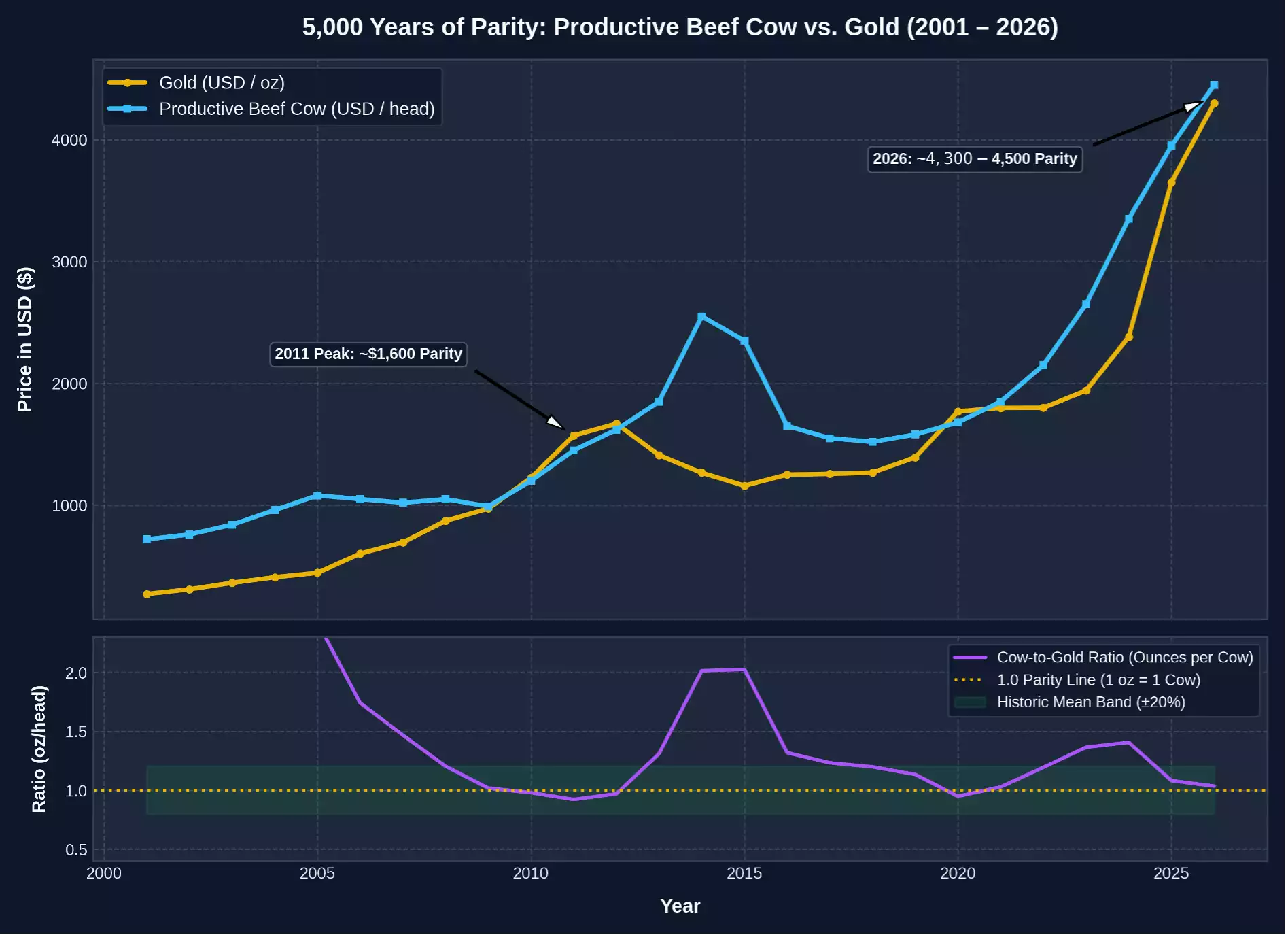
- 2011 to 2012: gold reached a then-record US$1,921 an ounce in September 2011 as Europe's debt crisis and the US credit downgrade drove safe-haven demand. Cattle rose over the same period, but nothing like as fast, and the ratio began compressing.
- 2020 to 2026: following historic global stimulus, US cattle broke out to record per-head prices on a contracting herd, with beef cow slaughter down more than 20% year on year in 2026. Gold moved further again, running to an intraday record of US$5,589.38 on 28 January 2026 before consolidating back toward US$4,400.
Notably, cattle achieved record nominal prices on genuinely tight supply, the most bullish fundamental backdrop a cow-calf producer could ask for, and still lost ground against gold.
How does this look in Australia?
Australian cattle have followed the same direction. Meat & Livestock Australia's Eastern Young Cattle Indicator broke through 1,000c/kg in June 2026 for the first time since 2022, and heavy cows passed A$4.20/kg at Dubbo, Wagga Wagga and Tamworth in late May 2026, with Dalby setting a saleyard record of A$4.42/kg. MLA attributed the rally to rain, restocker demand and strong global beef prices.
With AUD gold bid around A$6,120 an ounce on 8 September 2026, an ounce currently buys more than one head at those saleyard rates. The local ratio is not the same as the US one, which is a useful reminder that the cattle side of this comparison carries its own seasonal and currency cycle on top of the monetary one.
Where the Banks See Gold From Here
Institutional forecasts sit above spot. J.P. Morgan Global Research expects gold to average around US$6,000 an ounce by the final quarter of 2026 and to move toward US$6,300 by the end of 2027, after trimming its full-year 2026 average forecast to US$5,243 from US$5,708. UBS lifted its target to US$5,000 an ounce for the first three quarters of 2026, expecting a pullback to US$4,800 by year end and flagging US$5,400 if political or financial risks escalate.
The counter-case deserves airtime. J.P. Morgan's own bear case sits near US$4,340, around the 200-day moving average, and Greg Shearer, its head of base and precious metals, has pointed to the risk of US growth holding up while inflation accelerates, solidifying a Federal Reserve hiking cycle and cracking investor demand. On the cattle side, herd rebuilding is the classic corrective: as producers retain females and supply recovers, per-head prices have historically eased regardless of what gold does. The ratio is a long-run observation, not a trading signal, and it has clearly not been stable over the past twenty-five years.
A US$5,000 gold price would not necessarily mean gold has become expensive. On a century of cattle data it may simply mark another step in the erosion of the measuring unit.
What It Means for Investors
The point of the cow-to-gold ratio is not that livestock and bullion are interchangeable investments. It is that pricing a real, productive, supply-constrained asset in a currency that keeps expanding makes the asset look expensive, when much of the change sits in the measuring stick. Ainslie Bullion clients tend to arrive at the same conclusion from the other direction: they track wealth in ounces held rather than dollars quoted. For those building a position steadily rather than trying to time a peak, Ainslie's gold and silver bullion range and the Ainslie Saver facility are both structured around regular accumulation.
_______________________________________________
This article is general information only and does not constitute financial advice. Past performance is not indicative of future results. Always conduct your own research or consult a licensed financial adviser before making investment decisions.