Oil Markets Signal Potential Crash Ahead, While Bond Yields Spike on Inflation Fears
News
|
Posted 20/05/2026
|
1957
Key Takeaways:
- US 10-year bond yields have broken out of a multi-year consolidation range, driven by a resurgence in inflation fears, with April CPI at 3.8% (highest since May 2023).
- April PPI came in at 6% year-on-year, the highest reading since December 2022, confirming the inflation picture is broadening beyond energy.
- Historically, sharp oil price spikes have preceded deflationary crashes rather than sustained inflation, leading to rate cuts and central bank pivots.
- Precious metals have tended to pull back less than most assets during such crashes and rebound faster, while also benefiting from the monetary easing that follows.
-Compressed.jpg?ver=X5QA_SAcmDJLrs3m9g-vAQ%3d%3d "US 10-Year Government Bond Yield (Weekly)")
The US 10-year bond yield spiked this week, breaking out of a multi-year consolidation range. The move is being driven primarily by a resurgence in inflation fears, with the April CPI print at 3.8% (the highest since May 2023) and PPI at 6% year-on-year (the highest since December 2022, per the Bureau of Labor Statistics). The bond market appears to be pricing in inflation tied to the ongoing US-Iran conflict, with rate cuts increasingly off the table for now.
With the current inflation spike being largely energy-driven, and the energy spike being geopolitical in origin, a few important factors are worth considering.
First, this forward-looking expectation could quickly reverse on a shift in the geopolitical landscape.
Second, and more significantly: oil price increases are only inflationary when they rise in a slow and steady fashion, giving the move time to work through the economy. When oil spikes with a monthly rate of change above 100, history suggests it has preceded a deflationary crash in each prior instance. WTI crude is up over 65% in the past 12 months and the monthly ROC indicator is approaching that threshold, having read approximately 91 on the April close and climbing since. That type of crash has historically led to short-term pullbacks across most assets, followed by rate cuts, a collapse in bond yields, and a central bank policy pivot that tends to drive hard assets sharply higher.
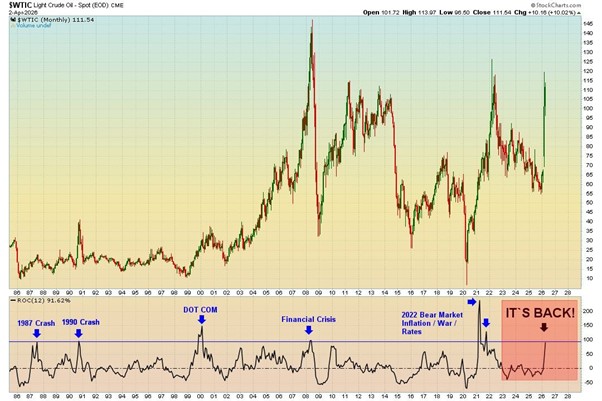
The question then is: how far off is such a crash, and are we approaching a peak in US bond yields? Before the pivot, comes the crash. After the pivot, comes inflation.
While almost all assets tend to pull back simultaneously during the crash phase, assets like gold have historically provided a store of value outside mainstream financial system volatility, pulling back less than most assets and rebounding faster. Gold has also tended to benefit most from the central bank monetary expansion that follows.
Investors who try to time this cycle precisely often get caught up in it. Precious metals investors with a longer-term outlook, by contrast, position themselves to weather the crash ahead of the central bank pivot, and to benefit from the inflation that follows.
At Ainslie Bullion, our team can help you understand how physical gold and silver fit into a portfolio designed to perform across this kind of cycle.
[Explore gold and silver at Ainslie Bullion →]
This article is general information only and does not constitute financial advice. Past performance is not indicative of future results. Always conduct your own research or consult a licensed financial adviser before making investment decisions.