Is the RBA Going Against Its Mandate?
News
|
Posted 25/11/2026
|
288
Key Takeaways
- The RBA is lifting rates while unemployment rises faster than it forecast.
- November's big job cuts aren't in the latest unemployment figure yet.
- Shoppers are still spending, but on essentials rather than retail.
- Government spending leaves rate rises doing all the work against inflation.
The Reserve Bank is deliberately pushing unemployment up, and the jobs market is already running ahead of its forecast. The bank's legal mandate has two goals, price stability and full employment. Yet five rate rises this year, to 4.85%, are aimed at weakening the labour market.
Unemployment jumped to 4.9% in October, its highest since October 2021, when economists had expected 4.7% (ABS, 19 November 2026). The RBA's own November forecast doesn't have unemployment reaching 5.1% until the end of 2028. With the recent spate of insolvencies and job cuts, that level could be reached much sooner.
The November redundancies aren't in October's figure. The survey ran from 27 September to 10 October, before David Jones, Canva, Qantas, Bunnings and General Pants announced cuts. Lendlease, another large employer, is also under pressure. By Ainslie Bullion's estimate, once those job losses land, unemployment could hit 5.0–5.1% by early-to-mid 2027. That is the RBA's end-2028 forecast, reached around two years early.
17 in every 100 jobs in Australia is in the public sector, many of them in health and education; in Japan this number is about 6. Recently Treasurer Jim Chalmers has made it clear the government won't go much further in cuts, only promising 'modest net savings' and 'cutting spending enough, without threatening growth'. It's hard not to make unemployment worse when so much of the economy runs through government.
The job cuts
More than a dozen big employers have announced cuts this year, and in November retail joined the banks and tech firms.
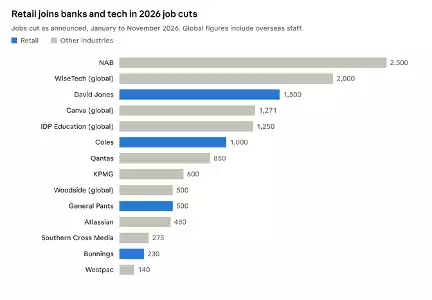
The November wave hit retail hardest: David Jones is closing 19 of its 38 stores, General Pants entered administration on 18 November, and Bunnings is offshoring part of its tech team to Tata Consultancy Services. Add to this the property woes and the recent Bathla collapse. Lendlease shares have fallen almost 70% this year, although the company says it has ample liquidity and no plans to raise equity.
What it means for unemployment
The announced redundancies alone could add about 0.1–0.15 percentage points, taking unemployment to roughly 5.0–5.1% through early 2027. The RBA doesn't forecast that level until the end of 2028. Its forecast is in trend terms, which smooth out monthly swings; trend unemployment was 4.8% in October, against 4.9% seasonally adjusted.
|
Step
|
Figure
|
|
Announced cuts, Australian share (estimate)
|
~10,500 (range 8,000–13,000)
|
|
Labour force
|
~15.5 million
|
|
Direct effect on the rate
|
+0.07 points
|
|
With flow-on to suppliers, landlords, local spending (x1.5–2)
|
+0.1 to +0.15 points
|
|
Starting point (October)
|
4.9%
|
|
Estimate once cuts land
|
5.0–5.1%
|
The Australian share is our estimate. Canva's 1,271 includes role changes and relocations, not just layoffs (Finimize), and WiseTech, Woodside and IDP figures are global. The labour force figure comes from 14.78 million employed in September (DEWR) at 4.7% unemployment.
The effect will be spread out. NAB's cuts run over the next year, and Bunnings' begin in the new year. Some workers will find new jobs quickly, and General Pants' 500 roles are at risk, not yet gone.
Headline layoffs are not the main driver. Slower hiring matters more: employment fell 36,400 in September alone, led by a fall of more than 70,000 part-time jobs (ABS, revised). That is more than every announced cut combined.
Consumer spending
Overall spending is still rising, but it's going to essentials, not shops. Household spending rose 0.6% in September to A$82.6 billion, beating forecasts of 0.2%, and was 6.8% higher than a year earlier.
The mix tells the story. Essentials rose 1.2% in the month, while discretionary spending rose just 0.3%. Furnishings fell 0.2% and clothing and footwear barely moved. Much of the essentials lift was fuel, health and air travel to major sporting events.
CommBank expects annual spending growth to slow to 0.7% by mid-2027, as the September and November rate rises flow through to mortgage repayments. Rising unemployment would add to that drag.
What is driving retail down
Retail is being squeezed by rates, prices and confidence all at once, on top of a long shift away from department stores.
- Interest rates. The RBA lifted the cash rate to 4.85% on 3 November, its fifth rise of 2026 and the highest since 2008.
- Property prices. Residential property was worth A$12.7 trillion before the budget. National values are already 6.7% below their March peak, and a 10% decline would leave households about A$1.3 trillion poorer.
- Cost of living. Inflation reached 4.9% in October, up from 4.3% in September, and petrol approaching A$2.40 a litre in early November has eaten into budgets.
- Confidence. Westpac's consumer sentiment index fell to 78.2 in November, a four-year low. Among mortgage holders it dropped to 68.1, the lowest since records began in 1994.
- Discretionary first. Spending on basics such as food is holding up while discretionary retail takes the hit. Footwear and liquor are weak; health and beauty are strong but declining rapidly.
- Structural change. Department stores' share of retail has fallen from about 14% in the early 1980s to about 5%, as discount chains and brand-owned stores took their customers. Online is about 13% of retail spending.
The result is a wave of collapses. Retail insolvencies hit 749 in the first ten months of 2026, according to ASIC data. Betts, Lincraft, A.H. Beard, Glue Store and Barbeques Galore have all faced administration, closure or wind-up this year.
The RBA is lifting unemployment on purpose
The Reserve Bank is raising rates into a weakening jobs market, the reverse of the usual playbook. Normally a central bank lifts rates when unemployment is falling and the economy is running hot. Inflation normally runs in the opposite direction to unemployment, but both have turned up since 2025.
The problem is that the RBA is fighting inflation alone. Public demand sits near record highs, at about 28–29% of GDP. Governor Michele Bullock has said public and private spending are both adding to demand while the economy is at capacity, though she has declined to single out government spending as making the bank's job harder. When an economy is at capacity and the biggest source of extra demand, the government, won't play ball, one of the RBA's two mandates has to give. Rates can't touch government spending, so the bank is choosing price stability over full employment. Households, businesses and workers carry the cost.
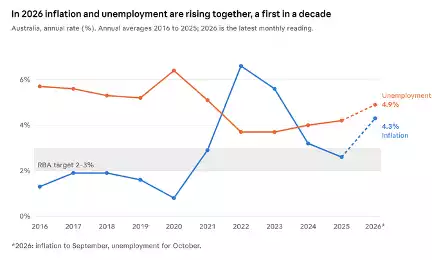
That sits awkwardly with the RBA's mandate. The Reserve Bank Act gives it two goals, price stability and full employment. Deliberately pushing unemployment up cuts against the second. The RBA would argue it is within its mandate. Full employment is defined as the maximum level of employment consistent with low and stable inflation, so with inflation at 4.9% in October it says jobs must give.
Worsening the ability of the RBA to maintain price stability is the declining Australian dollar. With the CGT changes, Australian investment is declining. Investment in Australian property is already showing this: the number of new investor home loans fell 30.6% in the September quarter. Tomorrow the ABS will release Private New Capital Expenditure and Expected Expenditure for the September quarter, which could show further weakness, although the RBA expects business investment, including data centres, to be stronger in the near term.
Outlook
Christmas will test how much retail can take. All 35 General Pants stores keep trading through Black Friday under administrators. Almost 1,700 David Jones staff at closing stores are competing for 170 redeployment roles. And the job losses could continue to pile on. Christmas may be a trading bandage, but 2027 could show how much of the economy now rests on government.
What it means for investors
When a central bank has to choose between its two goals, savers can lose either way: through weaker jobs, or through inflation and a falling dollar eroding cash. Historically, some Australians have held part of their wealth in physical gold and silver for that reason. Live A$ prices are on the Ainslie Bullion charts page.
________________________________________
This article is general information only and does not constitute financial advice. Past performance is not indicative of future results. Always conduct your own research or consult a licensed financial adviser before making investment decisions.