Is the Bond Market Pointing to a Stock Market Top?
News
|
Posted 21/10/2026
|
779
Key Takeaways
- US bond yields have historically topped months before major stock market peaks.
- Yields led the 2000 peak by seven months and the 2007 peak by four.
- A yield top is one probability signal, not a timing guarantee.
While investors attempt to make sense of the stock market moving up while global liquidity drops and economic conditions worsen, the current landscape is a stark reminder of how long markets can remain irrational for.
As we approach the end of the current 18.6-year land cycle (last one ended with the 2008 Global Financial Crisis) and the 80 year socio economic cycle called the Four Turnings (last one ended with the Great Depression), hunting for macro tops helps investors duck for cover ahead of time.
While these macro cycles have large timing windows for peaks, it's the US bond market that ultimately provides a sharper trigger for when to head to the exit, usually topping 3-9 months ahead of macro tops.
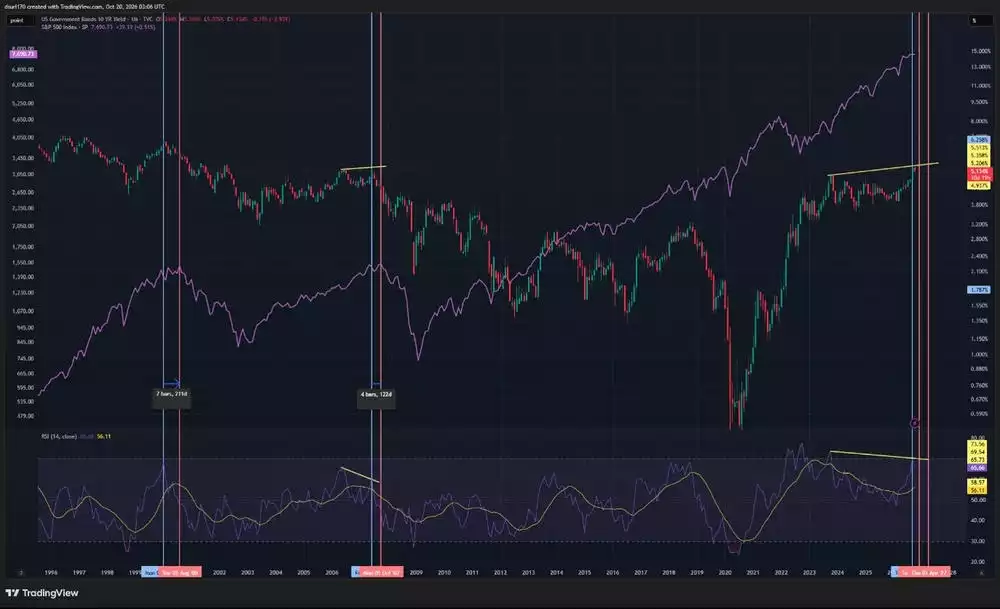
Yields topped before the last two major peaks
The chart above shows the US10Y bond yields topping 7 months prior to the stock market peak of the Dotcom bubble and 4 months prior to the peak before the Global Financial Crisis, after a period of rising yields. On the monthly series the 10 year peaked at 6.66% in January 2000 against an S&P 500 monthly high in August 2000, and at 5.10% in June 2007 against an S&P 500 monthly high in October 2007 (Multpl, 10 year rate, Multpl, S&P 500).
While these timeframes provide a rough guide, with a market anything is on the table, all of the time, meaning the top could be in right here right now, or could take longer than 7 months to come in. Framing the current financial landscape using the US bond market can be a potent indicator for further probabilistic edge.
As we look to the GFC as our precedent for the peak of the land cycle, we find an eerily similar setup with yields putting in a slightly higher high on the monthly chart with bearish divergence on the RSI preceding the drop. The 10 year sat at 5.12% on 20 October 2026, after a 5.31% high on 5 October (Trading Economics, 20 October 2026).
As this drop in yields kick in, bond market volatility spikes, with a pullback in bond market volatility between where yields top and the stock market tops, closely resembling today's setup. The MOVE index closed at 113.6 on 5 October 2026 and has eased back since (CoinDesk, 6 October 2026). This builds the expectation that peak could be as little as 3 months away for the SP500, ahead of what could be a generational crash.
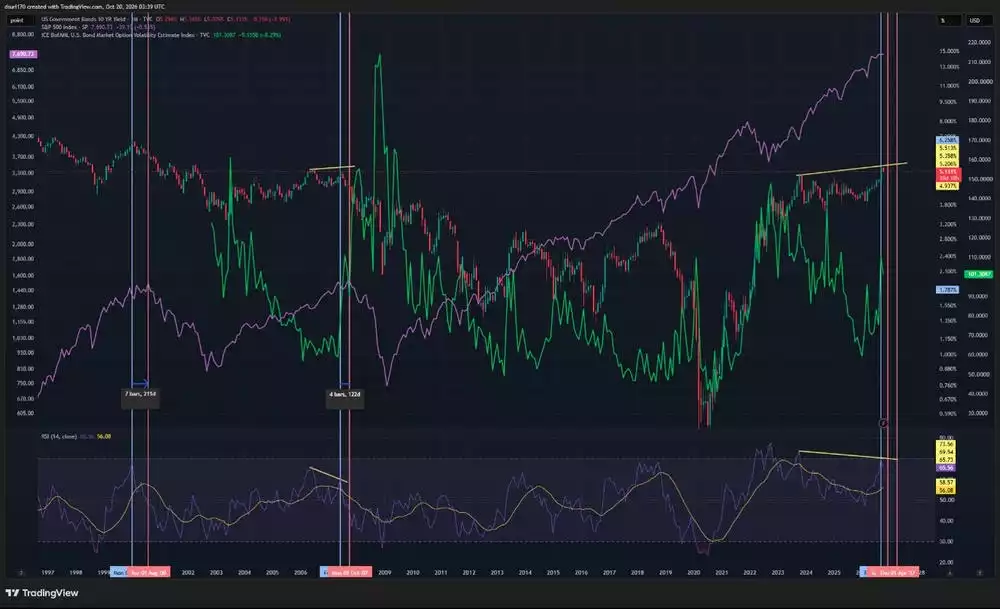
Two precedents are a small sample, and the MOVE measures the expected size of yield moves rather than their direction. Trading Economics models put the 10 year at 4.83% in twelve months, reading the same falling yield path as disinflation rather than crisis.
What it could mean for gold and silver
While such a crash would very likely lead to central bank intervention and money printing, hard assets like gold and silver are primed to benefit as they emerge from their half cycle lows this year ready for a move into the second half of their 8-year cycle. Gold traded at US$4,123.60 an ounce on 20 October 2026 (Trading Economics).
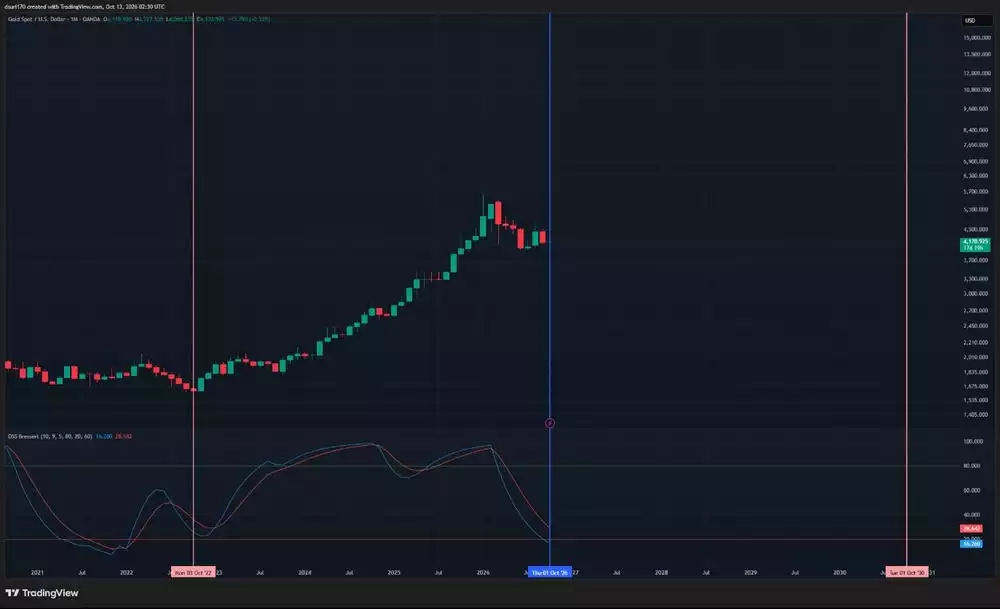
A bullish cross on the monthly DSS Bressert momentum indicator, with a swing low pattern, within this timeframe (late 2026) would mark the major half cycle low for gold and silver.
With the second half of the precious metals macro cycle taking place in an environment of low yields (historically supportive for metals) and central bank intervention, gold and silver are positioned to benefit. Ainslie Bullion has been helping Australians hold physical gold and silver since 1974, and on Ainslie's reading a cycle thesis favours accumulating through it rather than timing one entry.
*Charts by TradingView.*
_______________________________________________
This article is general information only and does not constitute financial advice. Past performance is not indicative of future results. Always conduct your own research or consult a licensed financial adviser before making investment decisions.