Is Your Super a National Asset? The Investment Problem Behind the Debate
News
|
Posted 07/08/2026
|
1770
Key Takeaways
- The government wants super invested at home, but trustees must put members first
- Super’s offshore allocation has climbed from around 35% to around 50% in a decade
- The pool has outgrown the ASX, with roughly $40 billion to deploy each quarter
- RBA research ties Australia’s productivity slowdown to weak business investment
- Where that capital ends up matters for anyone with retirement savings
The debate: whose super is it?
Prime Minister Anthony Albanese has said Australia’s superannuation savings have real potential to be treated as “a national asset”, speaking at a superannuation lending roundtable in July 2026. Super funds, banks and industry figures pushed back immediately, with Westpac chief executive Anthony Miller telling the room the system should not be directed on where to invest.
The tension is structural. Under the Sole Purpose Test (Superannuation Industry (Supervision) Act 1993, section 62), a fund must be maintained for the sole purpose of providing retirement, death or disability benefits to members. Trustees also carry a best financial interests duty to members.
A fund cannot simply be pointed at national-interest projects if doing so is not in members’ financial interests. That leaves a genuine policy question: if the government wants more of that capital invested in Australia, the more durable path may be to make Australia a more attractive place to invest, rather than redirecting retirement savings by mandate.
Australia has an investment problem
Australia’s productivity growth has lagged its OECD peers, and the investment story sits underneath it. The RBA research discussion paper Doing Less, with Less: Capital Misallocation, Investment and the Productivity Slowdown in Australia (RDP 2023-03, Jonathan Hambur and Dan Andrews, March 2023) finds that business investment has been weak and that capital has increasingly flowed to less productive firms rather than more productive ones.
The paper estimates that, had this slower reallocation not occurred, real output would have been around 0.75% higher by 2017, or about $13 billion, equivalent to roughly $1,000 per worker. It identifies declining competition and tighter access to external finance as contributing causes.
This is where superannuation becomes relevant. In principle, a large domestic savings pool should be a natural funder of local investment and productivity gains. In practice, a growing share is being invested offshore.
Why is super investing less at home?
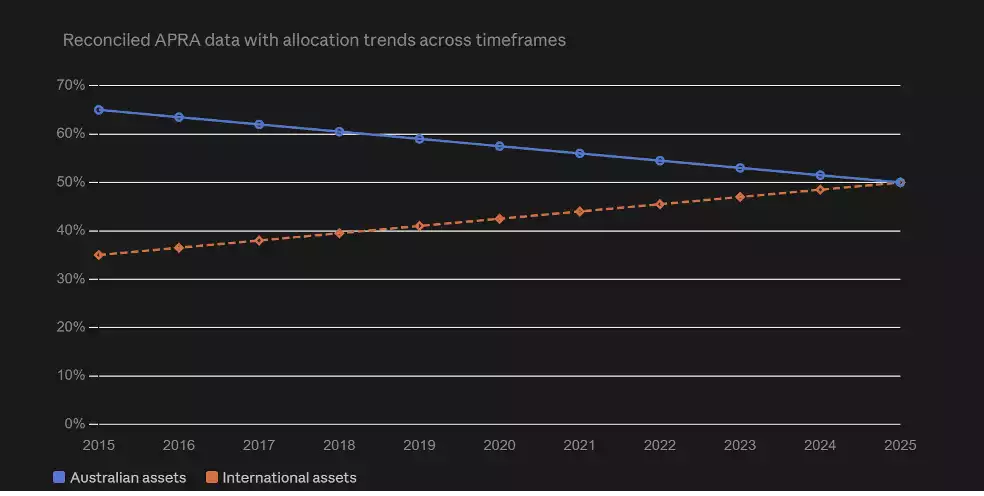
Superannuation’s allocation to international assets has risen from around 35% in 2015 to around 50% as at September 2025. That figure comes from the Association of Superannuation Funds of Australia (ASFA), drawing on APRA data, and covers the institutional segment of the system.
Self-managed super funds are a different story. Direct international investments account for just 2% of total SMSF assets, so the offshore shift is largely an institutional one.
Three factors sit behind the shift.
- Diversification. Investing offshore gives funds exposure to industries the local market barely has. Information technology companies account for around 20% of global stock market capitalisation but only around 5% of the ASX 200, which is weighted toward banks and miners. Broader exposure genuinely reduces concentration risk for members.
- Scale. Australia’s superannuation system holds $4.5 trillion in total assets, around 160% of annual GDP. The institutional segment alone needs to deploy roughly $40 billion of new capital every quarter. That is difficult for the ASX to absorb without funds becoming uncomfortably dominant owners of Australian companies.
- Trustee duty. Investment decisions, including the jurisdiction of the investment, are made to optimise long-run risk-adjusted returns for members. Where the strongest risk-adjusted opportunity sits offshore, that is where the capital goes.
|
Financial Year
|
SG Rate
|
Notes
|
|
1992–94
|
3.00%
|
Introduced by the Keating Government
|
|
1994–95
|
4.75%
|
|
|
1995–96
|
5.00%
|
|
|
1996–98
|
6.00%
|
|
|
1998–2000
|
7.00%
|
|
|
2000–02
|
8.00%
|
|
|
1 July 2002 – 30 June 2013
|
9.00%
|
Original target rate reached
|
|
1 July 2013 – 30 June 2014
|
9.25%
|
First scheduled increase takes effect
|
|
1 July 2014 – 30 June 2021
|
9.50%
|
Rate held from 2014
|
|
1 July 2021 – 30 June 2022
|
10.00%
|
Annual 0.5pt increases resume
|
|
1 July 2022 – 30 June 2023
|
10.50%
|
|
|
1 July 2023 – 30 June 2024
|
11.00%
|
|
|
1 July 2024 – 30 June 2025
|
11.50%
|
|
|
1 July 2025 – 30 June 2026
|
12.00%
|
Legislated target reached, current rate
|
Sources: rows from 1 July 2002 onward are from the ATO, Super guarantee percentage (Table 21), last updated 17 April 2026. The pre-2002 rows (1992–2002) are from the submitted draft 1] and are NOT on the current ATO published schedule; the ATO points to former sections 20 and 21 of the Superannuation Guarantee (Administration) Act 1992 for that period. Recommend a primary source for the pre-2002 rows before publishing, or attribute them as author-supplied history.
How franking credits shape the market
Australia’s franking (dividend imputation) system rewards companies for paying out profits, which favours mature, cash-generating businesses. This is one reason the mining and banking sectors dominate the ASX.
Because franked dividends carry an imputation credit for Australian shareholders, the tax system creates an incentive for companies to distribute profits as dividends rather than retain and reinvest earnings. That contrasts with the United States, where retained earnings and buybacks are treated more neutrally. Combined with high investment hurdle rates, Australian companies can face both a tax incentive and a risk-perception incentive to pay cash out rather than build new capacity.
The result, critics argue, is chronic underinvestment by listed companies in new business development. With a large share of the superannuation pool held by, or on behalf of, retirees who benefit from franking credits, any change to the settings would be complex to model and would have wide-reaching effects.
Supporters of dividend imputation argue the opposite case: it removes the double taxation of company profits, supports retirement incomes, and improves capital discipline by returning cash to shareholders rather than funding low-return projects. Any reform involves trade-offs rather than a clear win.
What other countries do differently
Some jurisdictions use targeted tax incentives to encourage early-stage investment. In the United States, the Qualified Small Business Stock provision (Internal Revenue Code section 1202) has allowed eligible founders and early investors in qualifying venture-backed C-corporations to exclude a capped amount of gain from federal tax where the stock is held long enough to qualify. The incentive is designed to reward risk-taking in early-stage companies.
Advocates point to incentives like this as one factor behind stronger US investment in higher-risk, higher-growth sectors. The broader question for Australia is whether the policy focus should be on creating more attractive investment opportunities, rather than on how retirement savings are allocated.
What it means for investors
The super allocation debate is really a debate about where long-term capital goes and why. For Australians thinking about wealth preservation, it is a reminder that the structure of the local market, heavily weighted toward banks and miners, shapes the risk and return profile of domestic portfolios.
That is one reason many investors look to diversify beyond equities. Ainslie Bullion has helped Australians hold physical gold and silver since 1974, and Gold Silver Standard offers tokenised precious metals for those who want exposure in digital form. Precious metals sit outside the equity market structure entirely, which is part of their appeal as a diversifier.
This article is general information only and does not constitute financial advice. Past performance is not indicative of future results. Always conduct your own research or consult a licensed financial adviser before making investment decisions.