Inflation Higher, Activity Lower, Australians Poorer
News
|
Posted 23/04/2026
|
1901
Key Takeaways
- RBA Deputy Governor Andrew Hauser (New York, 14 April 2026) and the IMF agree: Australia cannot look through the Iran oil shock the way other economies can.
- The IMF has urged economies with moderating inflation to be cautious about rate rises. Australia, with inflation still above target, has been given the opposite advice.
- Raising rates into an inelastic-supply shock layers cost-push inflation on top of supply-shock inflation. It is a lose-lose position.
- Australia walked into this shock already weakened by sustained population growth and record government spending. Peers arrived with more policy room.
- Australia looks headed for a stagflationary episode. Other countries are weathering the same storm with more shelter.
Wow. How’s that for a headline. Australia is facing a pretty bleak short-term outlook, and these are not our words. RBA Deputy Governor Andrew Hauser laid it out in New York on 14 April 2026, and the IMF has voiced the same picture. Australia has come in hot to the Iran oil supply shock, which means the RBA has no room to move in its interest rates but up. Other economies like the UK or the US, where inflation was already moderating going in, are being told by the IMF to hold rates longer and weather it out. The problem is that treating supply-shock inflation with rate rises can cause higher-for-longer inflation, and that is the future Australia is currently facing.
“The rates will have to go to a level that brings inflation back to target… if that means them going higher, it means them going higher… This is a big real income shock for Australia.”
Andrew Hauser, RBA Deputy Governor, New York, 14 April 2026
What the IMF Is Saying About Australia
The IMF put the same point in writing a couple of days later. In its 16 April blog “Asia’s Economic Resilience Is Being Tested by the Energy Shock,” co-authored by Asia and Pacific Department Director Krishna Srinivasan, Australia gets singled out directly:
“… where inflation is already above target and domestic demand pressures remain firm, such as Australia, the scope to look through the shock is more limited.”
IMF, 16 April 2026
This is in stark contrast to the recommendation the IMF has given other economies. The UK was downgraded in the same week’s IMF World Economic Outlook, with 2026 growth cut to 0.8 per cent and inflation tipped to peak around 4 per cent. The Bank of England’s governor has said publicly that the central bank is “not going to rush to judgments” on the energy shock. In other words, cautious. Australia does not have that luxury.
Unlike other economies such as the US, who leading into the Iran war were priced for one or two rate cuts in 2026 as inflation tapered, Australia’s inflation was well outside the RBA’s comfort zone. The latest monthly print (February 2026) had headline CPI at 3.7 per cent and the trimmed mean at 3.3 per cent, both above the 2 to 3 per cent target band. The March quarter CPI lands on 29 April and will tell us more. Sustained population growth and record government spending had us already poorer and activity already going backwards. Now, because of all that, we are facing the prospect of higher inflation that has to be dealt with almost regardless of the cost to the economy.
Supply Shocks: Why Rate Rises Backfire
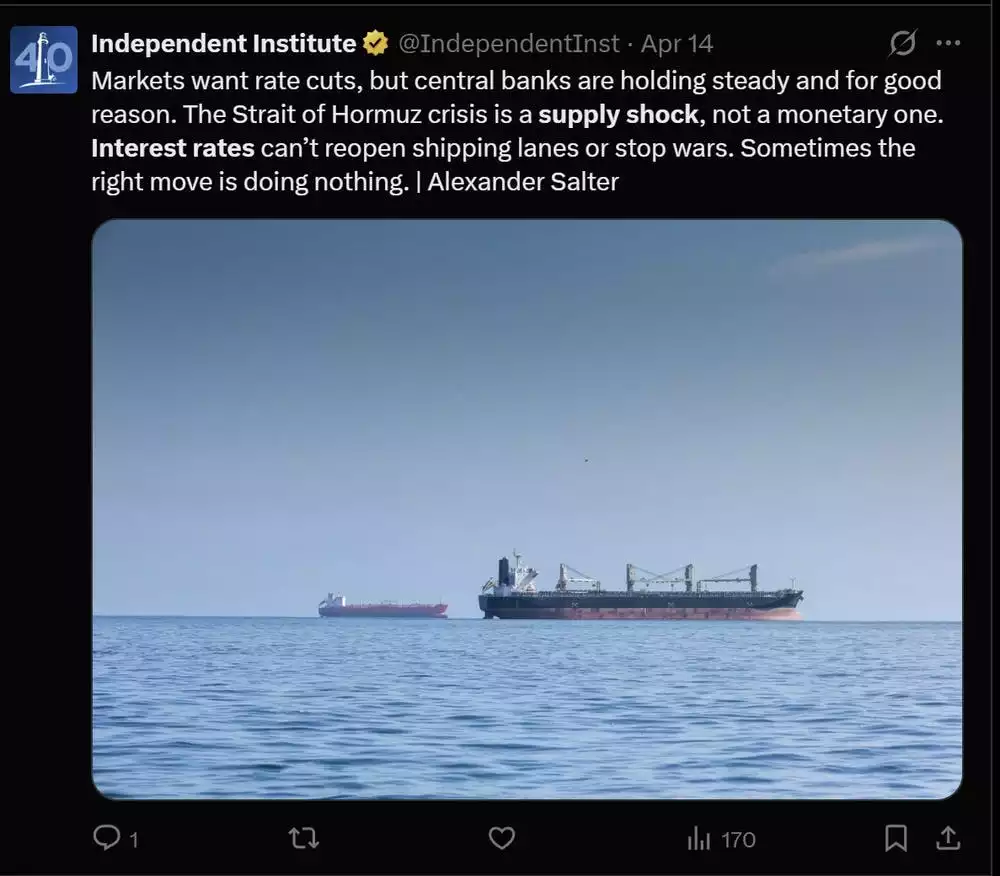
The Iran war has caused an almighty supply shock. Around 20 per cent of global oil transit and 35 per cent of global urea exports have been taken offline for 55 days and counting. Helium supply has lost roughly a third of global output after the Qatar Ras Laffan force majeure, and petrochemical and plastics feedstocks are experiencing what industry analysts have described as the biggest supply disruption in their history. These materials are inelastic. They cannot be substituted. People need to move around for work, goods need to be delivered, and people need to eat. Raising interest rates does not affect demand enough for inelastic goods. Monetary policy does not work in the way policymakers would like.
Monetary policy works successfully for demand-driven inflation. Think COVID. That started as a supply shock, with labour and goods slowing down. To get past the initial hit, central banks lowered interest rates to drive demand, which caused what was called “transitory inflation” but was actually demand-driven inflation. Everyone had money, driving demand and need for goods. That is when the microeconomic supply and demand curves work beautifully. Demand goes up, you move interest rates up to taper demand, and the system rebalances. In a supply shock, particularly involving an inelastic good such as oil or urea, the price does not temper your demand because you still need it. Raising interest rates in that environment causes what is known as cost-push inflation.
What Is Cost-Push Inflation?
Cost-push inflation is often used as the argument for why interest rates should not be raised during an inelastic-good supply shock such as oil. Higher interest rates raise the cost of business credit: loans for working capital, inventory financing, equipment. Firms often pass these higher financing costs through to prices. So you get a second source of cost-push inflation layered on top of the oil shock. This is sometimes called the “cost of capital” channel and is more significant when corporate debt is short-term or floating rate. This is why the IMF has warned economies whose inflation is already moderating not to raise rates.
Why Australia Has No Option
At the heart of the RBA’s dilemma is not the oil price itself, but what Australians come to expect about prices. When inflation runs persistently above target, as it has in Australia, workers begin to demand higher wages to protect their real purchasing power. Businesses, already absorbing higher input costs, grant those wage rises and pass them straight back through to prices. Each round reinforces the next. This is the wage-price spiral, and once it becomes entrenched it is extraordinarily difficult and costly to break.
The RBA’s primary tool for preventing this is credibility: the market’s belief that the central bank will do whatever it takes to bring inflation back to target. If the RBA is seen to look through yet another inflation impulse, expectations become unanchored. Workers, businesses and financial markets stop believing the 2 to 3 per cent target means anything. At that point, the RBA could lose control of the inflation narrative entirely, and the medicine required to regain it becomes far more severe than anything being contemplated today. It is precisely because rate hikes are a blunt and costly instrument against a supply shock that the RBA may have to use them anyway. The alternative, a 1970s-style stagflationary spiral, is worse.
The RBA is forced into a lose-lose position. They will have to raise, and in doing so, they will layer cost-push inflation on top of supply-shock inflation. Higher borrowing costs will flow through to businesses already absorbing elevated input costs. Financing costs rise, inventory costs rise (if they can even get the inventory, with plastics and urea already causing packaging and input strain), and those costs get passed on. The very mechanism that makes rate hikes counterproductive in an inelastic supply shock will play out in real time in the Australian economy.
The result is the bleak forecast. Higher inflation, lower activity, and Australians becoming materially poorer. Not just because of the Iran shock, but because we arrived at it already weakened, with no room to absorb it. Other countries are weathering a storm. Australia is weathering the same storm, but the leaky roof was never fixed. It’s going to be a cold, wet winter this time around
This article is general information only and does not constitute financial advice. Past performance is not indicative of future results. Always conduct your own research or consult a licensed financial adviser before making investment decisions.