How Much Does Australia's Economy Depend on China?
News
|
Posted 10/09/2026
|
1224
Key Takeaways
- China now takes more than a third of Australia's exports, a share that has risen despite a decade of new free trade deals elsewhere.
- Iron ore, Australia's biggest export, sends over 80% of its volume to China, leaving government revenue exposed to one buyer's pricing power.
- A new Chinese-backed mine in Guinea threatens that pricing power, while Canberra builds its own stockpile of critical minerals in response.
China and Hong Kong took 36.9% of Australia's goods exports in 2024, up from 34.8% a decade earlier, according to trade data cited by the Australian Strategic Policy Institute. Over the same period, Australia's other free trade partners collectively lost share, from 47.6% to 44.3%. Despite new trade deals with Japan, South Korea and others, the concentration in China has grown, not shrunk.
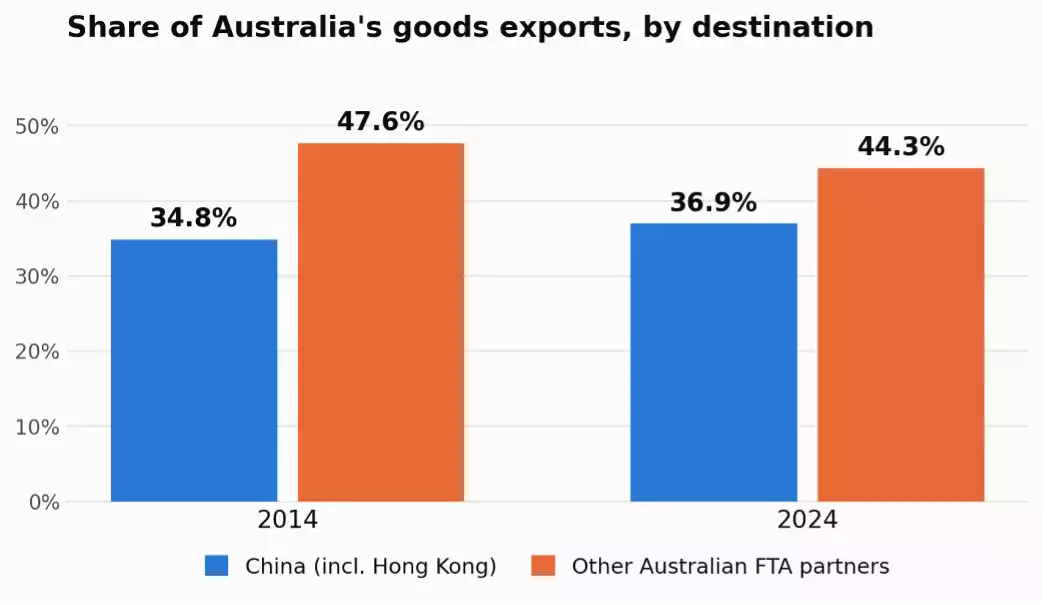
Australia has been here before. China's 2020-2023 restrictions on wine, barley and coal showed the risk materialising, but all were lifted by 2024, and China's share of Australian exports kept climbing regardless. Diversifying away from the world's largest buyer of the commodities Australia is best positioned to sell takes decades, not years.
One buyer, most of the ore
Iron ore is where the exposure is starkest. It's Australia's largest export by value, worth around $117 billion in 2025-26, and more than 80% of it goes to China. That's now facing its first real test: Guinea's Simandou mine, majority Chinese-owned and shipping since late 2025, will supply roughly 7% of global iron ore within five years at grades matching Australia's. Analysts expect this to pressure prices toward US$85 a tonne, and potentially below US$70, though these are projections, not certainties. Treasury estimates every US$10 fall costs the federal budget $400 million in the short term and $1.3 billion over the longer term.
The exposure runs both ways. China dominates processing of several critical minerals Australia itself needs, and tightened rare earth export licensing in October 2025. Canberra responded in April 2026 with a $1.2 billion critical minerals stockpile scheme and a March 2026 minerals deal with the EU, though analysts describe it as a step, not a fix. Longer term, China's shift toward recycled scrap steel could also more than halve its iron ore demand by 2050, on some industry estimates.
What it means for investors
None of this points to a crisis. Australia remains one of China's most important suppliers, and that cuts both ways. But it does mean a large share of government revenue and export income sits downstream of decisions made elsewhere. Gold offers a useful contrast: export earnings are forecast to rise 46% to around $68 billion in 2025-26, sold into a genuinely global market with no single dominant buyer, unlike iron ore's concentrated exposure. That's a structural observation, not a prediction about where any commodity price goes next.
This article is general information only and does not constitute financial advice. Past performance is not indicative of future results. Always conduct your own research or consult a licensed financial adviser before making investment decisions.