Gold’s 8 Year Cycle Shows Incredible Long-Term Potential Ahead
News
|
Posted 05/02/2026
|
3543
Since the US moved off the gold standard and the Bretton Woods system was dismantled, gold — priced in US dollars — has exhibited consistent eight-year cycles, measured from low to low.
The most recent eight-year cycle low occurred in late 2022, with the next expected around 2030. This places the “half-cycle” midpoint in late 2026.
A strong bullish cycle is typically right-translated, meaning the peak forms to the right of the midpoint (2026 in this case).
Given the current financial, socioeconomic and geopolitical landscape, it is reasonable to expect not only the current eight-year cycle to right-translate, but also the following cycle (2030–2038) to do the same.
Since the US weaponised the dollar against Russia in 2022 in response to the Ukraine conflict, global central banks have been stockpiling gold at roughly five times their historical pace. This reflects a deliberate move to diversify away from the US dollar as their primary safe-haven collateral. For the first time in decades, central banks are purchasing more gold than US bonds.
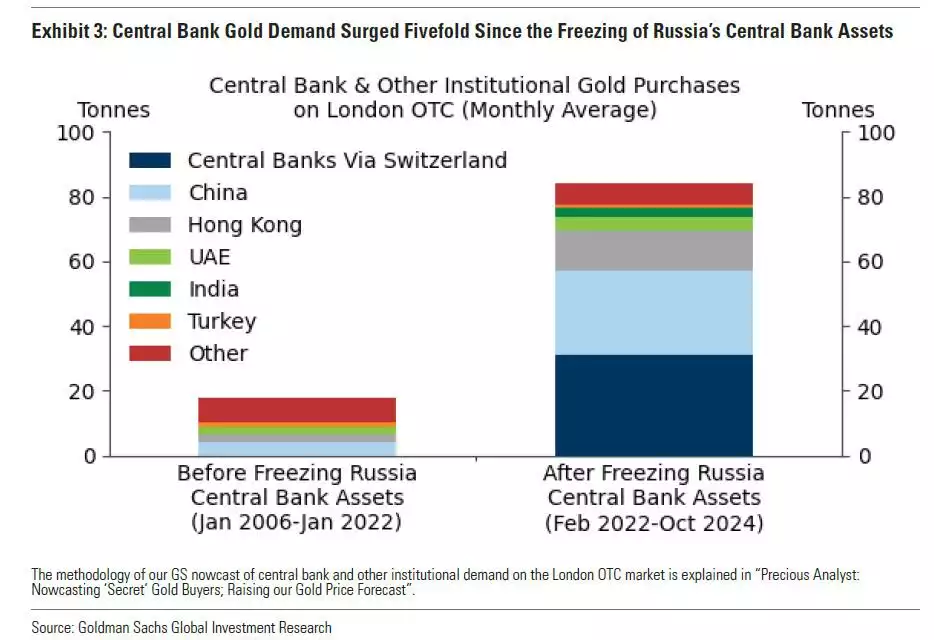
While central banks have been gradually reducing exposure to US debt for years, Moody’s recently downgraded US sovereign debt from AAA to AA+ — the last of the three major credit rating agencies to do so.
These developments are occurring in plain sight, alongside a technical and cyclical backdrop that strongly favours a long-term uptrend in gold.
Looking at the Gold vs S&P 500 bi-monthly MACD indicator below, we observe only four instances over the past 100 years where it crossed to the upside after a prolonged period below zero — each coinciding with a major shift in global financial markets.
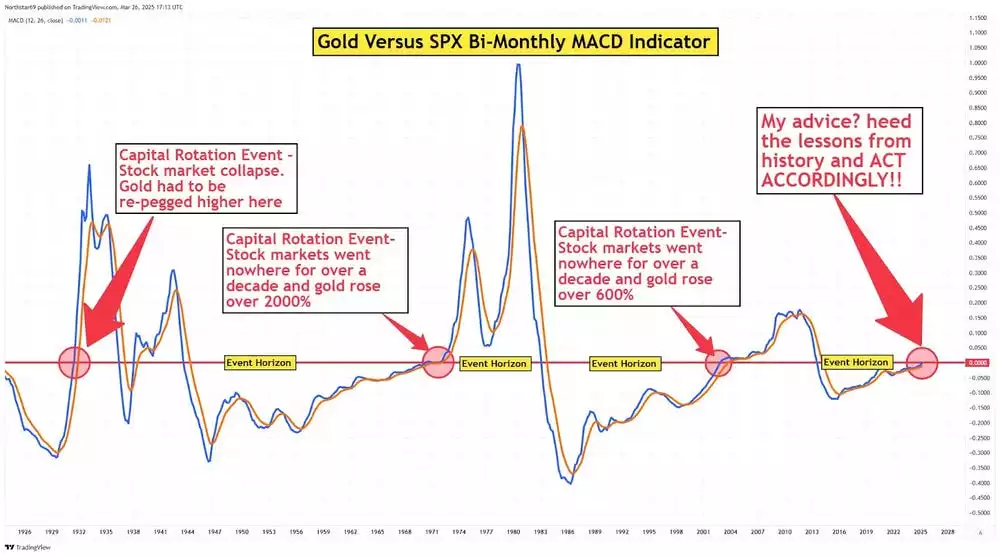
Source: @NorthStarCharts
In each case, equity markets subsequently traded sideways within a broad range for roughly a decade, while precious metals significantly outperformed.
8-year DXY cycle
Like gold, the US Dollar Index (DXY) has displayed consistent cyclical behaviour since the end of Bretton Woods. While the broader DXY cycle spans approximately 16 years, it can be broken into two eight-year sub-cycles.
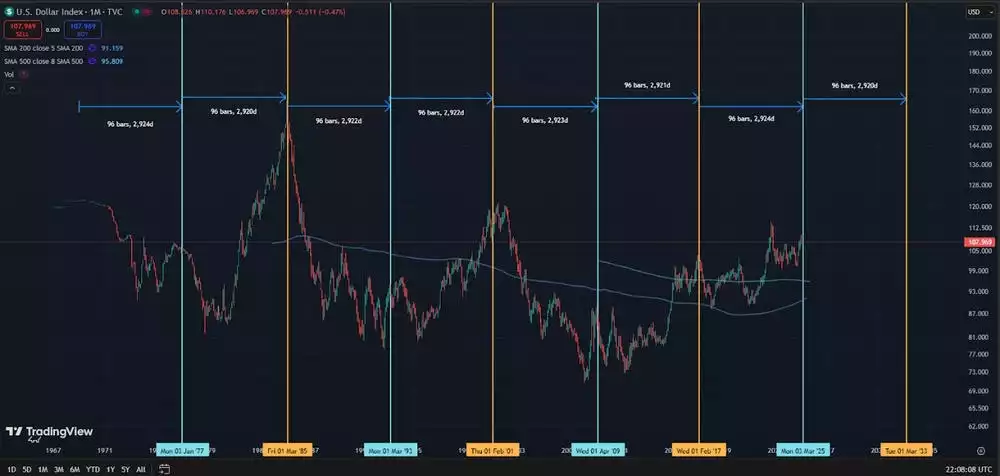
This cyclical framework supported expectations for a decline in the DXY from March 2025, at a time when many investors anticipated renewed dollar strength amid “America First” policy positioning. Since then, the DXY has already retraced meaningfully.
The cycle also suggests a potential rebound in the DXY into the 2030 timeframe — aligning with gold’s next cycle low, consistent with their inverse relationship.
More compelling is the indication that the DXY could weaken substantially after 2033, aligning with the start of gold’s next eight-year cycle. This would provide a favourable backdrop for a powerful advance in gold prices.
While we are not yet halfway through the current eight-year gold cycle, the following cycle may deliver the most significant gains, driven by pronounced dollar weakness during that period.
Taken together, this provides a decade-long view of the asset, highlighting substantial runway ahead.
While many call tops at each advance — or feel they are “too late” — stepping back reveals that, from a macro perspective, gold’s move may still be in its early stages.