Bond Market Complacency Leads to GSR Volatility: Opportunity for Silver Stackers
News
|
Posted 01/07/2026
|
1297
Key Takeaways
- Bond market volatility, measured by the MOVE index, has been compressing since March 2023, a setup that historically precedes a violent expansion in volatility.
- Low bond volatility has underpinned system liquidity this cycle; a sustained MOVE spike above the marked trendline would signal that dynamic reversing.
- A central bank response to a bond volatility spike could be a bullish catalyst for gold and silver as dollar devaluation resumes.
- A volatility spike could push the gold-silver ratio (GSR) sharply higher before it falls, which may present a long term entry point for silver.
The chart below shows bond market volatility compressing since March 2023 with the US10Y yields (green) forming a wedge pattern as the MOVE index (blue) measuring bond market volatility in aggregate in a sustained downtrend.
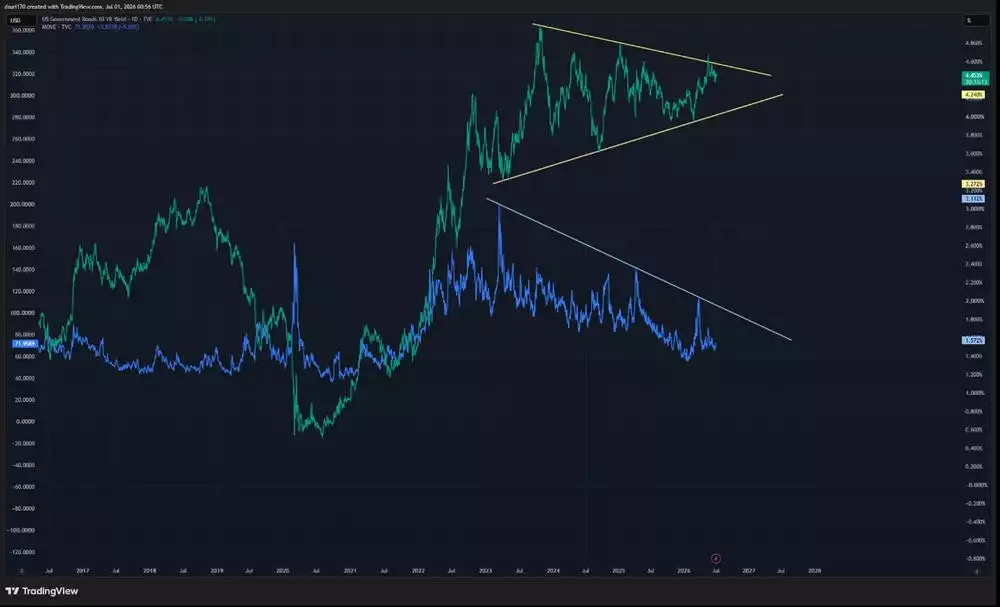
Low bond market volatility is essential for healthy markets, as the global financial system is entirely built on leverage on top of US bonds. When the collateral has increased volatility the liquidity on top of it takes a haircut due to increased risk premiums (the more volatile the asset, the higher the risk premium).
High yields generally lead to lower liquidity in the system as they coincide with low collateral values: the lower the value of the collateral, the less liquidity that can be leveraged on top of it.
With consistently elevated yields (resulting in low bond collaterals) over this entire liquidity cycle we can see the low bond volatility has been a significant factor in providing the liquidity required over this cycle (we saw the exact same setup leading into the 2007 Global Financial Crisis).
While volatility may continue compressing for a little while longer (the MOVE got down to 52 before the GFC) volatility compression precedes volatility expansion. And generally the longer any asset compresses, the more violent the expansion.
A spike in the MOVE index that holds above the trendline marked is a clear warning sign to run for the exit, as it shows a phase of heightened volatility coming up in bonds.
It's important to note that while falling yields (meaning higher bond collaterals) tend to coincide with falling interest rates, which the markets interpret as bullish for assets, this can actually coincide with financial Armageddon if the bond volatility is spiking at the same time. This is because while steadily falling yields (steadily increasing bond collaterals) and falling interest rates are great for liquidity (where the MOVE index would remain suppressed), having rates fall off a cliff and bond collaterals spike aggressively (with the MOVE index spiking) is an environment where central banks are aggressively cutting, while investors pile into bonds. This is aggressive easing amid flight to safety, usually a dynamic due to a systemic financial break.
With the same setup at the GFC in the bond markets today, and record compression in volatility, all eyes are on the MOVE index as stock market investors dance close to the exit.
For PM investors, a central bank response to a spike in bond market volatility would be an enormously bullish catalyst for the next wave of dollar devaluation amid the second half of the macro 8 year gold and silver cycles. Any systemic financial instability would be an opportunity to position for the next macro leg as metals have historically recovered first and fastest in such environments.
For silver investors specifically, a spike in bond market volatility would coincide with a spike in the GSR, which could then be followed by the GSR falling off a cliff in the months that follow, as silver is more volatile than gold on the pullback as well as the recovery. This could present a long term opportunity to allocate to silver at an unnaturally high GSR that drops amid the central bank policy intervention which follows.
This article is general information only and does not constitute financial advice. Past performance is not indicative of future results. Always conduct your own research or consult a licensed financial adviser before making investment decisions.