Australia’s Budget vs Singapore’s Plan: What the Numbers Say About Wealth Creation
News
|
Posted 18/05/2026
|
4091
Key Takeaways
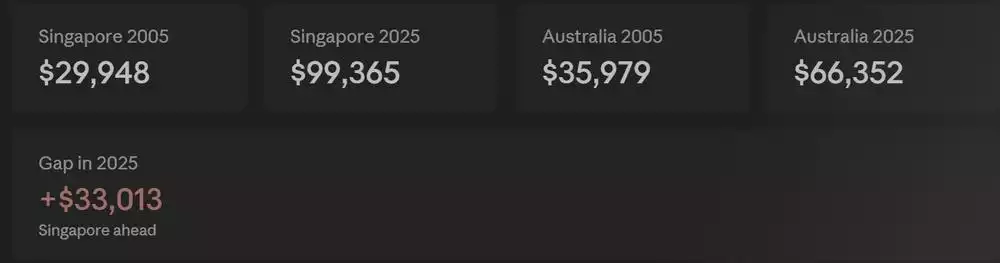
- Singapore’s GDP per capita reached US$99,365 in 2025, up from US$29,948 in 2005 — a gain of roughly 230% over two decades while Australia grew from US$35,979 to US$66,352 over the same period.
- Singapore released its Economic Strategy Review (ESR) in May 2026, a forward-looking blueprint focused on productivity, competitiveness, and long-term capacity building.
- Australia’s 2026-27 Budget projects a deficit of A$28.3 billion, with CGT discount removal and negative gearing restrictions among the headline policy changes.
- The philosophies are essentially mirror images: Singapore is asking how do we attract more, while Australia’s budget is more focused on how do we redistribute what we have.
- For investors focused on wealth preservation, the divergence in approach raises questions worth understanding.
This week, two very different economic visions were put on the table.
On 12 May 2026, Australia handed down its 2026-27 Federal Budget. A day later, Singapore released the final recommendations of its Economic Strategy Review (ESR), a comprehensive blueprint developed over nine months through consultations with more than 7,700 stakeholders.
In 2005, Australia’s GDP per capita was $35,979 and Singapore’s was $29,948. Fast forward 20 years and two commodity booms, and Singapore is now 50% higher than Australia in GDP per capita terms. The contrast is worth examining — not as a political debate, but as a data question.
The Wasted Commodity Boom
Rather than channelling commodity proceeds into productive investment, Australian policy actively redirected capital into real estate. The 50% CGT discount introduced in 2000 made negative gearing far more attractive, and instead of ushering in a new wave of investment in information technology, it fuelled an old-fashioned Australian property boom.
Poor tax policies encouraging housing speculation over productive investment became a structural drag, and the damage was lasting. New private business investment peaked at around 18% of GDP during the mining boom but fell back to less than 12% after it ended, and non-mining investment remained subdued even as the boom faded. The mining boom crowded out non-mining investment; when the boom ended, nothing filled the gap.
Singapore: No Resources, All Strategy
While Australia was riding two commodity booms, Singapore had no oil, no iron ore, no LNG. It had to manufacture prosperity entirely from policy. It kept corporate tax at 17%, attracted global headquarters, built world-class port and financial infrastructure, invested heavily in education and R&D, and maintained fiscal surpluses to fund long-term capacity. Every dollar of growth was earned — none was gifted by geology.
The ESR vs Australia’s Budget
Singapore’s ESR, presented at the Singapore Business Federation’s Future Economy Conference on 13 May 2026, is structured around three imperatives: sharpening Singapore’s value proposition, enhancing agility and adaptability, and building resilience alongside efficiency. Its 32 recommendations span AI capability, startup ecosystem development, next-generation logistics infrastructure, and workforce transition support.
The tone is explicitly pro-business. It is an attempt to drive productivity, provide support to businesses and allow them to seize opportunities. Deputy Prime Minister Gan Kim Yong described it as being about how Singapore positions itself for the longer term to stay competitive, create good jobs, and remain relevant in a more fragmented, contested and fast-changing world.
Australia’s 2026-27 Budget takes a different emphasis. The headline measures include removal of the 50% CGT discount (replaced by cost-base indexation), negative gearing restrictions on established residential properties, a A$250 tax offset, and an instant A$1,000 tax deduction for work-related expenses. The underlying cash deficit sits at A$28.3 billion.
The philosophies are essentially mirror images: Singapore is asking how do we attract more, while Australia’s budget is more focused on how do we redistribute what we have.
The Budget Fallacy: It’s Not Going to Help People Into Houses
The labour government has stated it aims to help more Australians buy homes, and yet it stands in stark contrast to Singapore’s policy, where 90% of Singaporeans own their own home.
Singapore’s pro-business, low-tax, surplus economy has achieved individual property ownership at levels Australia aspires to — and their approach is the opposite. They incentivise people to buy property and apply cooling measures for higher-order purchases through the Additional Buyers Stamp Duty (ABSD).
ABSD was first introduced in December 2011 to cool the residential market and has been revised upward several times since. It is a tax on top of normal stamp duty, and the rate depends heavily on who is buying. Singaporeans pay 30% ABSD on their third and subsequent properties; Permanent Residents pay 30% on their second and 35% on their third; foreigners pay 60% on any residential property; and non-individual entities (companies) pay 65%. It means properties are significantly cheaper for first home buyers.
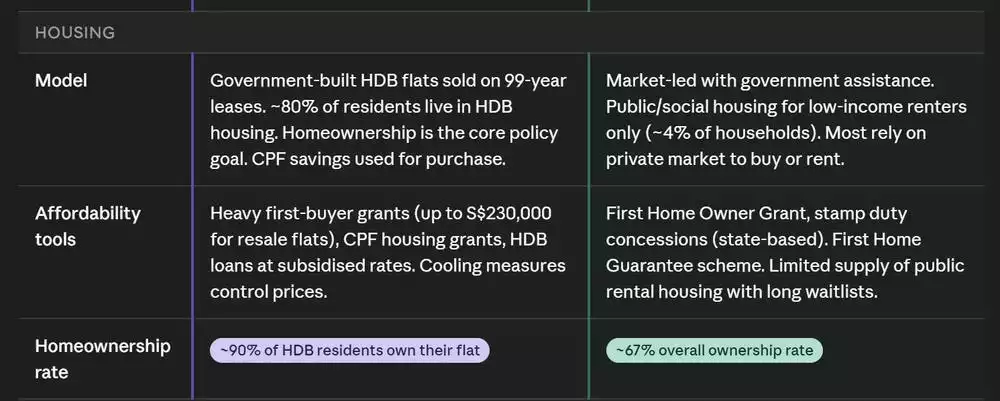
Australia’s homeownership rate sits at approximately 67%. First Home Owner Grants and stamp duty concessions exist at state level, but the structural settings, including negative gearing and the CGT discount now being wound back, have historically favoured investors over first buyers.
What It Means for Investors
The policy directions announced this week have direct implications for Australian investors. The removal of the CGT discount and the negative gearing restrictions on established properties change the return profile on residential property investment from 1 July 2027. For investors reassessing their asset allocation, these are material shifts.
Historically, periods of significant tax or policy change have prompted investors to reconsider how much of their wealth is held in assets subject to government discretion, and how much is held in assets outside that reach. Gold and silver have served that function across different economic environments — assets that cannot be repriced by legislation.
Ainslie Bullion has been helping Australians hold physical gold and silver since 1974. If you’d like to understand how precious metals fit alongside a changing investment landscape, our team is available to help.
This article is general information only and does not constitute financial advice. Past performance is not indicative of future results. Always conduct your own research or consult a licensed financial adviser before making investment decisions.