A 30-Year-Old Ad Predicted Today's Prices. It Wasn't Magic, It Was Maths.
News
|
Posted 03/08/2026
|
1397
Key Takeaways
- A 1996 TIAA-CREF ad forecast decades of price rises simply by extending average inflation forward
- At 2% inflation, prices rise about 81% over 30 years and a dollar loses almost half its purchasing power
- Cash holds its number but quietly loses value, which is why gold keeps drawing demand from savers
In 1996, US retirement provider TIAA-CREF published an advertisement warning that within thirty years, a burger and fries could cost US$16, a holiday could cost US$12,500 and a basic car could cost US$65,000. What was laughed at when it was released now looks like a reasonable estimate.
The obvious reaction is that its creators somehow predicted the future. According to the advertising team, they simply took the average rate of inflation and extended it forward thirty years.
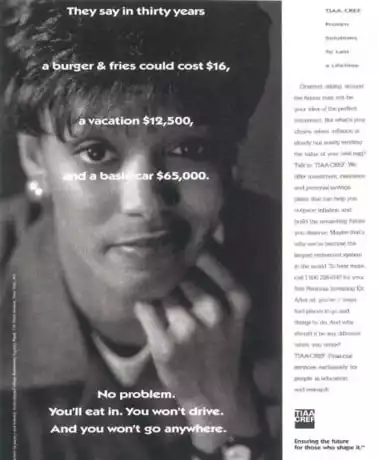
Inflation does not need to become hyperinflation to materially damage wealth. It only needs time. At an inflation rate of 2% per year, prices rise by approximately 81% over thirty years. Put another way, a dollar loses almost 45% of its purchasing power. At 3% inflation, prices more than double and the currency loses almost 59% of its purchasing power.
This is why inflation can appear relatively harmless from one year to the next. A few extra dollars for dinner, a slightly higher insurance premium or another increase in rent can be absorbed. Compounded over an entire working life, the effect is enormous.
The US Federal Reserve judges that 2% inflation over the longer run is most consistent with its mandate for maximum employment and price stability. Australia's Reserve Bank targets inflation of 2 to 3% on average over time for similar reasons. Yet a 2% target does not mean prices remain stable. It means the currency is expected to lose purchasing power every year at a controlled rate.
Periods of higher inflation make the problem even more obvious. When inflation eventually falls, prices generally do not return to where they were. They simply begin rising more slowly from a permanently higher base. Disinflation is not the same thing as falling prices.
This distinction matters for savers. Cash feels safe because the number displayed in a bank account does not fluctuate. But nominal stability is not purchasing power stability. A balance of $100,000 can remain unchanged while the quantity of housing, food, travel and energy it can purchase steadily declines.
It also explains the continuing demand for gold. Gold cannot be created in response to government spending requirements or financial stress. Its supply grows slowly and predictably, which allows investors to measure part of their wealth outside a monetary system built around continued currency expansion.
The gold price will still fluctuate, sometimes significantly. But over the long term, the relevant question may not be how high gold can rise. It may be how much further government currencies can fall against the things people actually need.
What it means for investors
The point is not that a currency is about to collapse. Deep, liquid currencies like the Australian and US dollars are backed by large, productive economies. The point is that steady, controlled inflation is doing exactly what it is designed to do, and cash sitting idle wears down over time.
That is the case many investors make for holding a portion of their wealth in precious metals. Ainslie has been helping Australians own physical gold and silver since 1974, and Ainslie Bullion offers a full range of gold and silver for investors looking to hold value outside the fiat system.
Explore gold and silver at Ainslie Bullion →
This article is general information only and does not constitute financial advice. Past performance is not indicative of future results. Always conduct your own research or consult a licensed financial adviser before making investment decisions.